

Average Accountancy Fees for a Limited Company UK 2026: The Complete Pricing Guide
Why does one quote for your annual accounts sit at £600 whilst another reaches £3,000 for what appears to be the same workload? It’s a confusing discrepancy that often leads to anxiety about hidden charges or the fear of an HMRC investigation due to poor filing. Understanding the average accountant fees for limited company uk is about more than just finding the lowest price; it’s about securing a diligent guardian for your business’s financial health.
You likely feel that your accounting should be a tool for growth rather than just a compliance headache. This guide provides a clear benchmark for 2026 market rates, ensuring you don’t get ripped off while still receiving the proactive tax planning your company deserves. We’ll examine the typical £100 to £300 monthly retainer models, the impact of the £90,000 VAT registration threshold, and how a “beyond the books” approach helps you focus solely and truly on your goals. By the end of this guide, you’ll know exactly how to value professional expertise that keeps you compliant and tax-efficient.
Key Takeaways
- Understand why annual quotes fluctuate between £600 and £3,000 by learning how transaction volume and tax complexity dictate your final bill.
- Establish a clear 2026 benchmark for the average accountant fees for limited company uk to distinguish between basic filing and high-value tax efficiency.
- Identify common red flags in low-cost quotes that frequently lead to surprise charges and hidden fees later in the financial year.
- Learn how to navigate the 2026 compliance landscape, including the £90,000 VAT threshold and Making Tax Digital requirements, without the stress of HMRC penalties.
- Discover the benefits of a fixed-fee, “beyond the books” partnership that provides predictable costs whilst you focus on growing your business.
Why Limited Company Accountant Fees Vary So Widely in 2026
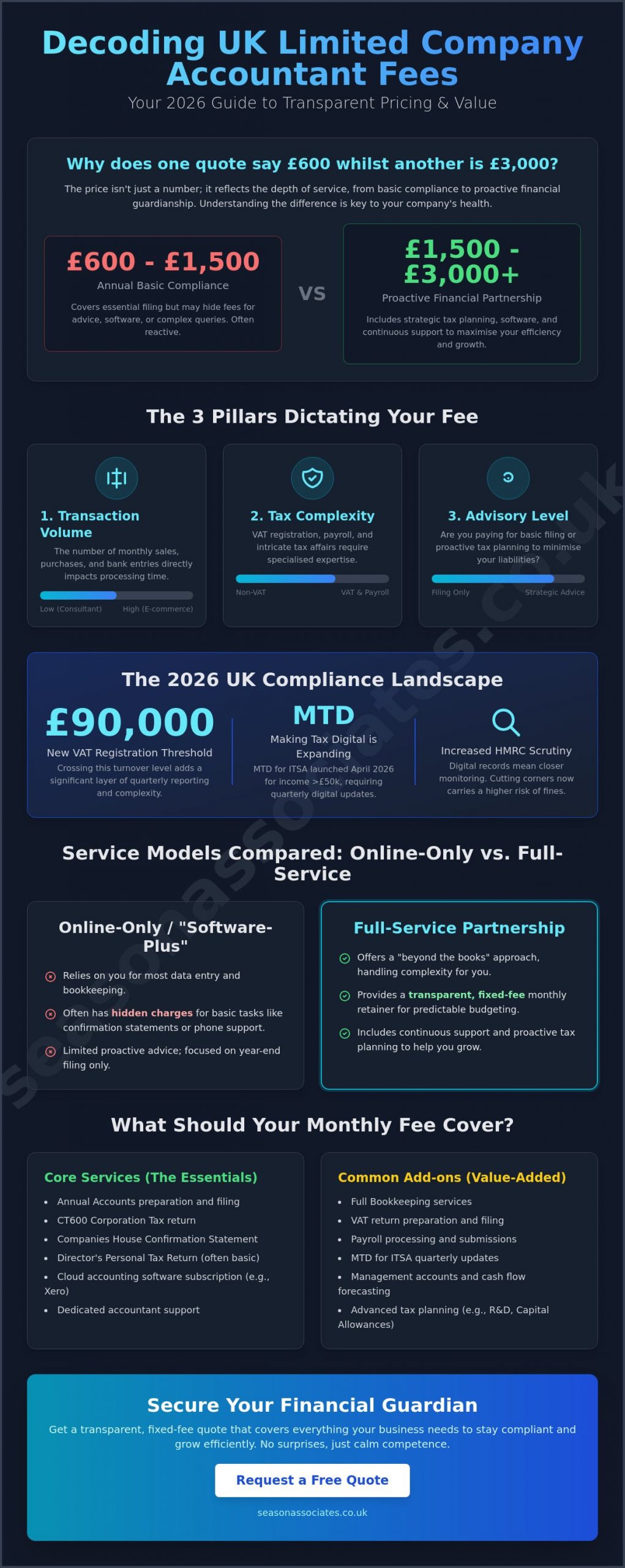
Have you ever wondered why one firm quotes £800 for your annual accounts whilst another suggests £2,500 for the same business? This variation isn’t just arbitrary pricing; it reflects the depth of the “diligent guardian” role an accountant plays. In 2026, the average accountant fees for limited company uk typically range from £600 to £1,500 for basic compliance, but this figure shifts quickly as your business grows. Standard accounting today must align with UK Generally Accepted Accounting Practice (UK GAAP), ensuring every transaction is recorded with precision to satisfy both Companies House and HMRC.
Fee structures rest on three specific pillars that dictate your monthly or annual investment. First, the volume of transactions matters. A consultant with ten monthly invoices requires far less processing time than an e-commerce brand with thousands of micro-transactions. Second, the complexity of your tax affairs, such as being VAT-registered or managing a team via payroll, adds technical layers. Finally, the level of advisory makes a difference. You aren’t just paying for a simple filing; you’re paying for proactive tax planning to minimise your Corporation Tax liability effectively.
HMRC has significantly increased its regulatory scrutiny as of May 2026. With the rollout of Making Tax Digital (MTD) for various tax heads, accountants must monitor records more closely than ever to prevent errors. This heightened oversight has standardised certain fee minimums because “cutting corners” now carries a much higher risk of expensive fines and investigations. Investing in “calm competence” ensures you aren’t just buying a service. You’re buying a shield against complications, allowing you to flourish without the weight of financial anxiety.
The Shift from Annual to Monthly Retainers
The traditional model of handing a box of receipts to an accountant once a year is obsolete. In 2026, successful limited companies use monthly retainers to maintain real-time information. This approach spreads the cost, helping your business cash flow whilst ensuring you’re always ready for a VAT return or a sudden management account request. It turns accounting into a continuous support system that identifies potential tax savings long before the year-end deadline arrives.
Online-Only vs. Full-Service Accounting Firms
You might see budget online-only packages that appear affordable at first glance. These “software-plus-support” models often rely on you doing the heavy lifting of data entry. If you have a complex structure or aim for high growth, a professional full-service firm is essential. Budget packages often hide charges for basic tasks like filing a confirmation statement. A transparent partner offers a fixed-fee approach with no hidden surprises, allowing you to focus solely and truly on your goals.
Core Services vs Add-ons: What Your Monthly Fee Actually Covers
Are you tired of “menu-style” pricing that leaves you guessing your final bill? When looking at the average accountant fees for limited company uk, it’s vital to distinguish between the statutory “must-haves” and the value-added extras. Most standard packages cover your annual accounts, the CT600 Corporation Tax return, and your Companies House confirmation statement. The 2026 landscape has introduced new layers of complexity. For instance, Making Tax Digital (MTD) for Income Tax Self-Assessment (ITSA) launched in April 2026 for directors with property or business income over £50,000. This shift means your personal tax return is no longer just a once-a-year task. It requires quarterly digital updates that may or may not be bundled into your monthly fee. Establishing a benchmark for the average accountant fees for limited company uk helps you avoid the “cheap quote” trap where basic needs are billed as extras.
Professional bodies provide clear guidance on accountancy fees, emphasising that transparency is key to a healthy partnership. A reliable firm acts as your diligent guardian, ensuring that cloud software like Xero or QuickBooks isn’t just an expense, but a window into your company’s real-time health. If you’re unsure if your current quote covers these 2026 requirements, you can request a transparent fee review to gain total clarity.
The Bookkeeping Boundary
Where does your work end and ours begin? This is the single biggest factor affecting your costs. If you use modern tools to capture receipts “with just a click of your finger”, you reduce the manual labour required from your accountant. “Shoebox accounting”, handing over physical piles of paper, is increasingly rare and expensive. Automated bank feeds and digital record-keeping allow us to monitor records closely. This prevents errors before they ever reach HMRC.
Payroll and CIS: The Complexity Multipliers
If you have employees, payroll adds a layer of Real Time Information (RTI) reporting that HMRC demands. Most firms charge a base fee plus a per-head cost for each employee. Similarly, if your business operates within the Construction Industry Scheme (CIS), the additional filing requirements for monthly returns and subcontractor verifications command a premium. Pension auto-enrolment is another essential. Whilst some firms treat this as a chargeable extra, a supportive partner often integrates it to ensure you remain fully compliant without surprise bills.
Calculating Fees Based on Company Turnover and Complexity
Most UK accountancy firms use your annual turnover as the primary starting point for a quote. This isn’t because they want to charge more just because you’re successful; rather, turnover acts as a proxy for professional risk and the sheer volume of records that require monitoring. As your revenue climbs, so does the complexity of your tax planning needs, especially since the 25% Corporation Tax rate now applies to profits over £250,000. For a standard limited company with a turnover between £100,000 and £200,000 in 2026, the average accountant fees for limited company uk typically fall between £1,200 and £2,500 per annum depending on whether you require full-service bookkeeping or just year-end compliance.
Complexity adjustments can shift these figures further. If your business engages in international trade, manages multiple VAT schemes, or handles complex R&D tax credit claims, the time required to act as your diligent guardian increases. These factors require a deeper level of technical expertise to ensure you don’t fall foul of HMRC regulations. By understanding these tiers, you can move from a state of uncertainty to a state of clarity regarding your investment.
Estimated Fee Tiers for 2026
Micro-entities or dormant companies can often maintain their status for as little as £400 to £600 per year, focusing purely on “keeping the lights on” with Companies House. Small companies and contractors earning between £50,000 and £150,000 sit in the sweet spot for fixed-fee monthly retainers, usually paying between £100 and £150 per month for core compliance. Once your turnover exceeds the £250,000 mark, you transition into a growing SME category. At this level, fees often range from £300 to £800 per month as you require more frequent management accounts and detailed tax planning to flourish.
The Impact of Transaction Volume
Why does an e-commerce business with £100,000 in turnover often pay more than a consultant with the same revenue? The answer lies in the transaction count. A consultant might only raise 12 invoices a year, whilst an online shop might process 5,000 micro-sales across various platforms. Each of these transactions needs to be reconciled. Whilst automated software integrations like Xero can mitigate these costs by pulling data “with just a click of your finger”, the accountant must still verify the accuracy of these automated bank feeds. Manual entry for high-volume businesses is a relic of the past; embracing modern tech-savvy mentorship is the most effective way to keep your fees affordable whilst ensuring your records remain accurate.
Evaluating a Quote: Red Flags and Value Indicators
Receiving a quote that sits well below the average accountant fees for limited company uk might feel like a financial win for your startup. However, a “bargain” fee often masks a reactive service model that only addresses problems after they arise. These low upfront costs frequently lead to surprise billing for basic advice or phone calls that you likely assumed were included in the package. True transparency is the ultimate trust signal. You should look for a firm that offers a clear “no hidden charges” guarantee; this allows you to budget with total confidence whilst your business begins to flourish.
Your accountant should be a tech-savvy mentor who uses modern tools to provide real-time information. If a firm isn’t pushing for cloud-based integration, they’re likely wasting your time and money on manual processes. Proactive tax planning is where the real value lies. A £2,000 annual fee is a wise investment if your accountant identifies £10,000 in Corporation Tax savings through efficient dividend structures or capital allowances. If you want to see how a transparent, value-driven fee structure looks in practice, get a tailored quote from Season Associates to secure your business’s future.
Questions Every Director Should Ask Before Signing
Before you commit, ask if your personal Self-Assessment is included in the company fee. With the 2026 rollout of MTD for ITSA, this is more critical than ever. Inquire about how the firm handles an HMRC tax investigation. Do they offer insurance to cover the professional fees, or will you face an unexpected bill for the extra work? Finally, ensure you’ll have a dedicated point of contact. You need someone who understands your specific goals rather than a generic helpdesk that doesn’t know your history.
The ROI of Expert Tax Advice
Moving beyond compliance is what separates a business enabler from a mere record-keeper. A diligent guardian identifies opportunities for R&D tax credits and ensures your salary-to-dividend split remains optimal as tax rates evolve. This expertise prevents the £100 fines that plague unorganised small businesses. By monitoring your records closely, a professional firm ensures you never miss a deadline. This proactive approach means the average accountant fees for limited company uk are often offset by the tax efficiency and penalty prevention they provide. You’re paying for the freedom to focus solely and truly on your goals.
Beyond the Books: How Season Associates Provides Transparent Value
At Season Associates, we believe that your accountant should be a catalyst for your personal and professional freedom. Our philosophy is built on a foundation of “calm competence”, moving beyond the books to act as a genuine business enabler for entrepreneurs across the UK. We understand the anxiety that comes with varying market quotes. Whilst the average accountant fees for limited company uk provide a useful benchmark for your budget, we focus on delivering predictable, fixed-fee monthly packages that eliminate the fear of surprise bills. Our approach is fundamentally supportive. We position ourselves as a reliable shield against the complexities of HMRC regulations, allowing you to flourish without the weight of financial stress.
Our expertise extends into highly regulated niche sectors where detail-oriented oversight is non-negotiable. Whether you are managing a healthcare practice, a legal firm, or a prominent charity, our team provides the specialised technical knowledge required to maintain compliance. We don’t just crunch numbers. We monitor your records closely to identify potential tax savings and ensure your salary-to-dividend split remains optimal as regulations evolve. By taking the time to explain the “why” behind every tax decision, we guide you from a state of uncertainty to a state of total clarity.
Our Integrated Cloud Approach
We embrace a modern, forward-thinking trait evidenced by our deep integration with cloud-based systems. By implementing Xero or QuickBooks for your business, we provide you with real-time information regarding your financial health. This “click of a finger” accessibility demystifies the often-intimidating world of accounting. It allows you to see your profit and loss or upcoming VAT liabilities at a glance. Our tech-savvy mentorship ensures that your digital records are accurate and up to date, which is essential for meeting the 2026 requirements of Making Tax Digital. We handle the technical complications. You handle the growth.
Get a Transparent Quote Today
Are you ready to secure a diligent guardian for your business? We invite you to a free consultation to discuss your specific company goals and transaction volumes. Our commitment to “no hidden charges” ensures that you receive affordable excellence without the sting of unexpected costs. We pride ourselves on being a prominent partner for UK SMEs, offering a level of service that justifies your investment by preventing fines and maximising tax efficiency. When you align with us, you aren’t just paying for a service; you’re investing in a partnership that allows you to focus solely and truly on your goals.
Request a tailored quote from Season Associates today and discover how our transparent approach to the average accountant fees for limited company uk can help your business accomplish its full potential.
Secure Your Business Future with Clarity and Confidence
Choosing the right partner means moving from a state of uncertainty to a state of total financial clarity. We have explored how transaction volume and the 2026 regulatory landscape dictate the average accountant fees for limited company uk, proving that the cheapest quote often hides the highest risks. By focusing on value-add services like proactive tax planning and real-time monitoring, you ensure your business remains a vehicle for success rather than a source of stress.
At Season Associates, we provide the tech-savvy mentorship you need to flourish. Our fixed-fee monthly retainers come with a strict no hidden charges guarantee, giving you predictable costs and expert oversight through Xero and QuickBooks. Whether you are a contractor, a scaling SME, or operating in a niche sector like healthcare, our team acts as your diligent guardian. It is time to move beyond the books and start scaling with precision. Focus on your goals whilst we handle the books; get your transparent quote today and let us help you accomplish your full potential with calm competence.
Frequently Asked Questions
Do I legally need an accountant for my limited company in the UK?
No, there is no legal requirement to hire a professional accountant. However, as a director, you are personally responsible for the accuracy of your filings under the Companies Act 2006. Making a mistake can lead to personal liability or hefty fines from HMRC. Most directors choose professional support to act as a diligent guardian against these risks.
Are accountant fees tax-deductible for a limited company?
Yes, accountancy fees are a fully tax-deductible business expense. Because these services are “wholly and exclusively” for the purpose of your trade, you can offset the cost against your company’s income. This reduces your overall taxable profit, which in turn lowers your Corporation Tax bill at the end of the financial year.
How much should a small limited company pay for an accountant monthly?
A small limited company should typically expect to pay between £100 and £300 per month. This range for the average accountant fees for limited company uk usually covers your annual accounts, corporation tax, and basic payroll. If you require more frequent management accounts or complex tax planning, your monthly investment will naturally sit at the higher end of that scale.
What is the difference between a bookkeeper and an accountant for a limited company?
Bookkeepers focus on the daily recording of financial transactions whilst accountants provide higher-level tax advice and statutory filings. A bookkeeper ensures your Xero or QuickBooks records are accurate “with just a click of your finger”. An accountant then uses that data to minimise your tax returns and ensure you meet all legal deadlines with Companies House.
Can I change accountants mid-year if I am unhappy with the fees?
You can change your accountant at any point during the financial year. If you feel your current fees are too high or the service is reactive, the switching process is simple. Your new firm will handle “professional clearance”, which involves requesting your previous records from your old accountant to ensure a seamless transition without any data loss.
Should I pay extra for tax investigation insurance?
Paying for tax investigation insurance is a wise investment for peace of mind. HMRC has the power to open an inquiry into any business at random. Whilst the insurance doesn’t pay the tax owed, it covers the professional fees your accountant charges to defend you. This prevents a surprise bill that could otherwise reach thousands of pounds.
Does company turnover always dictate the accounting fee?
Turnover is a common benchmark, but transaction volume often has a bigger impact on your fee. A business with £200,000 turnover and 5,000 monthly sales requires more monitoring than a consultant with £500,000 turnover and only 10 invoices. Accountants look at the complexity of your VAT scheme and the number of employees before providing a final quote.
What happens if I file my own accounts and make a mistake?
Making a mistake on your own accounts leads to immediate financial penalties and increased HMRC scrutiny. Late filing penalties for annual accounts start at £150 and can reach £1,500 if left for over six months. Beyond the fines, errors in your Corporation Tax return can trigger a full audit, causing significant stress and potential back-tax payments.



https://shorturl.fm/6kQla