
Essential Tax Return Dates 2026: A Complete Guide for UK Taxpayers
Imagine the evening of 31 January, you’re at your desk, frantically searching for a missing P60 whilst the HMRC website buffers, knowing a single minute’s delay could trigger an automatic £100 fine. It’s a stressful scenario familiar to over 12 million people across the UK annually, often leaving them overwhelmed by the complexities of various filing requirements. You deserve to focus solely on your business goals, rather than losing sleep over misinterpreted deadlines or missed payment windows.
At Season Associates, we act as your diligent guardian, providing a reliable shield against these complications. This comprehensive guide is designed to help you master the essential tax return dates 2025, ensuring you stay compliant and keep your hard-earned money where it belongs. We’ll provide a clear, jargon-free calendar of every critical HMRC deadline for the upcoming year, giving you the total peace of mind that comes with being organised and prepared. From Self Assessment to Corporation Tax, we’ll break down exactly what you need to file and when, allowing your business to flourish without the burden of tax-related anxiety.
Key Takeaways
- Navigate the unique UK tax year cycle and prepare your business for the transition toward Making Tax Digital to ensure seamless compliance.
- Master every critical deadline, from registration to final submission, by following our comprehensive guide to tax return dates 2025.
- Learn the essential “9 months and 1 day” rule for Corporation Tax and how to accurately calculate your specific quarterly VAT filing dates.
- Discover proactive ways to organise your financial records to avoid costly HMRC penalties starting at £100 and rising with daily interest.
- Explore how a “beyond the books” partnership provides the calm competence you need to focus solely and truly on your professional goals.
Understanding the UK Tax Year Cycle and Why Dates Matter
Are you feeling the pressure of the approaching tax deadlines? Running a business in London is demanding enough without the constant worry of HMRC compliance hanging over your head. At Season Associates, we believe in going beyond the books to ensure you flourish. Understanding the tax return dates 2025 brings is the first step toward reclaiming your peace of mind and protecting your hard-earned profits. We act as a reliable shield, ensuring that the complexities of the system don’t hinder your professional freedom.
The 2025 calendar year serves as a critical transition period for thousands of UK entrepreneurs. As the government moves closer to the full implementation of Making Tax Digital (MTD) for Income Tax Self Assessment in April 2026, 2025 is the year to refine your digital record-keeping. If your business turnover exceeds £50,000, you’ll soon be required to provide quarterly updates. Moving to cloud-based systems like Xero or QuickBooks now ensures that you’re not just reacting to changes, but actively managing your growth with real-time information.
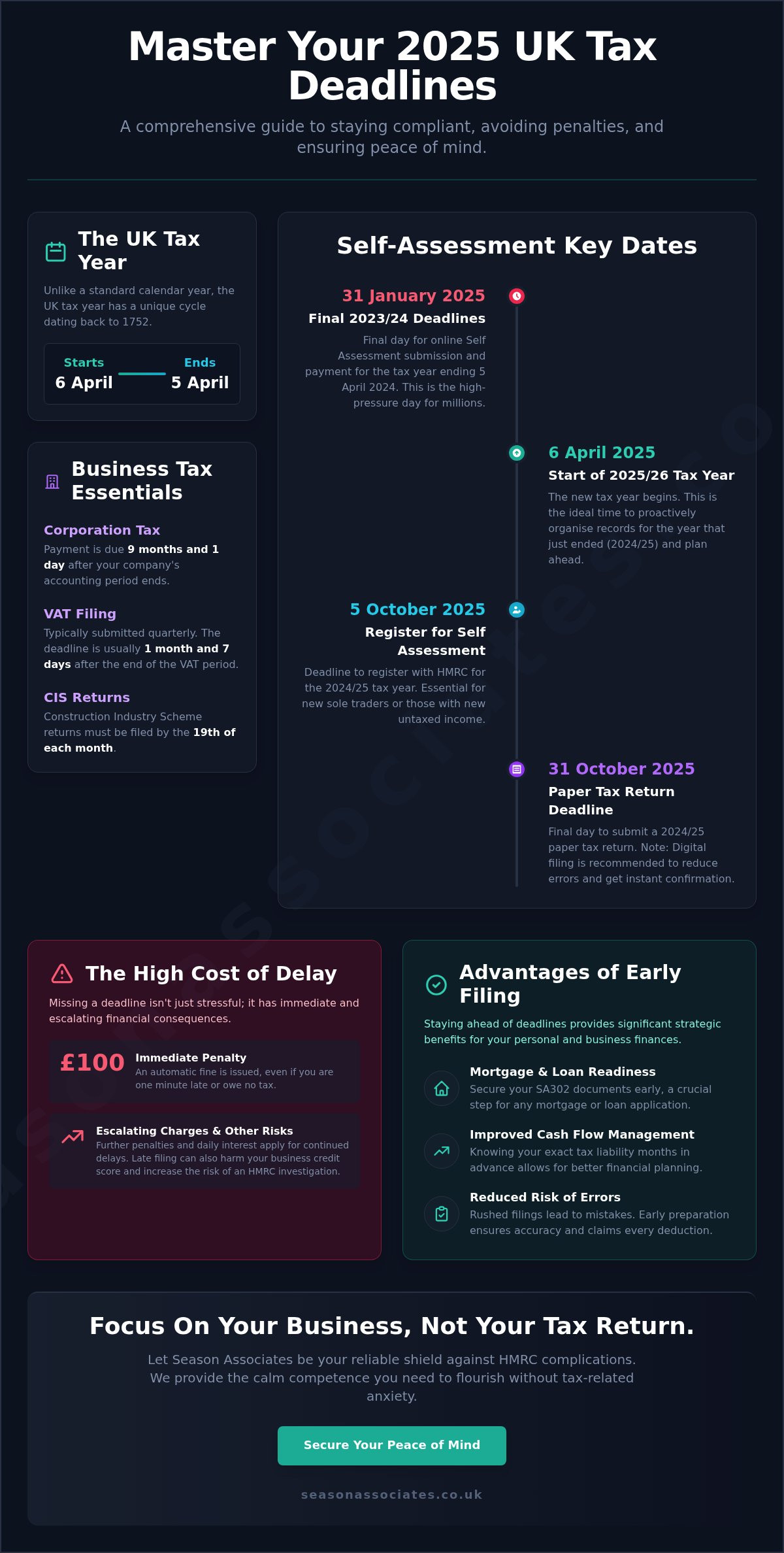
The 6 April to 5 April Logic
Why does the UK tax calendar feel so out of sync with the rest of the world? This unique cycle dates back to 1752, when the British Treasury moved from the Julian to the Gregorian calendar. To ensure no tax revenue was lost during the shift, they added 11 days to the old New Year’s Day of 25 March, landing us on 6 April. This window dictates your £12,570 personal allowance and determines which tax bands apply to your annual earnings. If you wait until the 31 January deadline to look at your 6 April records, you’ve already lost the chance to adjust your financial strategy. We encourage our clients to start their year-end prep on 6 April. This proactive approach allows us to monitor records closely and identify potential tax savings whilst there is still time to act.
The Importance of Timely Filing
Missing a deadline isn’t just about the immediate £100 automatic penalty, though that is a frustration no business owner needs. A history of late submissions can negatively impact your business credit score and may signal a lack of internal control to HMRC, potentially increasing the risk of a formal investigation. By staying ahead of the tax return dates 2025 requires, you gain several strategic advantages:
- Mortgage Readiness: You can secure your SA302 documents early, which is essential for personal loan or mortgage applications.
- Cash Flow Management: Knowing your exact liability months before the payment is due allows for better capital allocation.
- Error Reduction: Rushed filings lead to mistakes; early prep ensures every deduction is accurately claimed.
You can find detailed information on the specific forms required for UK tax returns, such as the SA100 for individuals or the CT600 for companies, to better understand your obligations. Our mission is to relieve you of these complications, allowing you to focus solely and truly on your goals whilst we handle the technical rigour of the HMRC cycle.
Self-Assessment Tax Return Dates for 2025
Are you feeling slightly overwhelmed by the approaching financial deadlines? It’s a common sentiment amongst London’s vibrant community of entrepreneurs and sole traders. Staying informed about the tax return dates 2025 is the first step toward reclaiming your peace of mind. By tracking these milestones early, you move beyond the books and position yourself to focus solely and truly on your goals. HMRC operates on a strict cycle, and missing a single date can lead to immediate £100 fines, even if you don’t owe any tax.
Registration and Paper Filing Deadlines
If you have recently transitioned into self-employment or started receiving untaxed income, your first hurdle is 5 October 2025. This is the final date to register for Self Assessment for the 2024/25 tax year. You can complete this process via the Self Assessment deadlines page on the GOV.UK portal. If you register after this date, HMRC may issue a “failure to notify” penalty, which is often calculated as a percentage of the tax due.
Whilst most people now choose digital routes, some still prefer traditional methods. The deadline for submitting a paper tax return is 31 October 2025. We generally advise against this; paper filing is becoming increasingly rare because it lacks the instant validation of online software. HMRC statistics suggest that manual returns are significantly more prone to errors, which can trigger unwanted investigations. If you miss the October paper deadline, you must file online by January to avoid penalties. Our team can help you transition to digital systems, which relieves you with all the complication of manual record-keeping.
The 31 January Midnight Milestone
The date 31 January 2026 represents the most critical point in the UK tax calendar. By midnight, you must have submitted your online return and paid your remaining tax bill. This often involves a “balancing payment,” which covers the tax you owe for the previous year that wasn’t already paid through payments on account. If you want HMRC to collect your tax automatically through your PAYE tax code, you must submit your online return much earlier, by 30 December 2025, provided your bill is under £3,000.
One of the biggest pitfalls for small businesses is the “Payment on Account” system. If your tax bill exceeds £1,000, HMRC usually requires you to pay half of your estimated next year’s tax upfront on 31 January. This can create a cash flow crunch if you aren’t prepared for a bill that is effectively 150% of what you expected. We focus on detailed tax planning to ensure these tax return dates 2025 don’t catch you off guard. By monitoring records closely throughout the year, we help you set aside the accurate amount, allowing your business to flourish without the anxiety of a January surprise.
Business Tax Calendar: VAT, Corporation Tax, and CIS
Are you feeling overwhelmed by the constant stream of HMRC notifications? Running a Limited Company in London brings a unique set of pressures, but staying ahead of your tax return dates 2025 is the best way to ensure your venture continues to flourish. We’re here to act as your diligent guardian, ensuring you never miss a beat whilst you focus solely and truly on your goals.
Most VAT-registered businesses operate on quarterly cycles. Your specific filing and payment deadline is usually one calendar month and seven days after the end of your VAT period. Since Making Tax Digital (MTD) became mandatory for all VAT-registered entities in April 2022, you must use functional compatible software to submit these records. This real-time information approach helps you maintain an accurate view of your cash flow, preventing nasty surprises when the payment date arrives.
Limited Company and Corporation Tax Deadlines
Understanding the “9 months and 1 day” rule is vital for your financial planning. Unlike personal tax, your Corporation Tax payment is typically due before you even file your Company Tax Return (CT600). If your accounting period ends on 31 December, your payment is due by 1 October the following year. However, you have 12 months from the end of your accounting period to actually file the return with HMRC.
Filing your accounts with Companies House is a separate requirement that usually shares a deadline nine months after your year-end. Aligning your accounting period with the tax year can simplify this process, though it is not mandatory. You can find a comprehensive breakdown of business tax deadlines to help you coordinate these filings throughout the calendar year. Our approach goes beyond the books to ensure these two distinct filing obligations never overlap in a way that causes cash flow strain.
VAT and CIS: Ongoing Compliance
For those in the London construction sector, the 19th of every month is a date that requires your full attention. This is the deadline for submitting your monthly Construction Industry Scheme (CIS) returns. If you’re a contractor, you must tell HMRC about all payments made to subcontractors. Staying on top of these specific tax return dates 2025 ensures your construction firm avoids the heavy-handed penalties HMRC applies to late filers, which start at £100 for being just one day late.
Payroll compliance follows a similar monthly rhythm. Your Full Payment Submission (FPS) must reach HMRC on or before your employees’ payday. You then have until the 22nd of the month to pay any PAYE and National Insurance due electronically, or the 19th if you still pay by post. We provide a reliable shield against these complications, allowing you to accomplish your professional milestones with just a click of your finger. By monitoring records closely, we ensure your business remains a prominent example of compliance in a competitive market.
Preparing for 2025: Avoiding Penalties and Stress
Are you feeling the weight of the upcoming tax return dates 2025? It’s a common anxiety for many London entrepreneurs, but it doesn’t have to be a source of dread. Most late filings occur because of simple administrative hurdles, such as misplaced receipts or a lack of clarity regarding “payments on account.” When you leave your submission until the final days of January, you lose the opportunity to review your figures for potential tax reliefs. This rush often leads to errors that can trigger an HMRC enquiry, adding even more pressure to your schedule.
HMRC maintains a strict penalty regime to encourage compliance. Missing the midnight deadline on 31 January results in an immediate £100 fine, even if you have no tax to pay or have already paid your bill in full. If the delay extends to three months, HMRC adds a £10 daily charge for up to 90 days, potentially reaching a total of £1,000. Beyond this, further penalties of 5% of the tax due (or £300, whichever is greater) are applied at six and twelve months. By using cloud accounting software like Xero or QuickBooks, you can see your liabilities in real-time. These tools allow you to move “beyond the books” and gain a clear, proactive view of your financial health.
The True Cost of Late Filing
The financial impact of being late goes beyond flat fines. HMRC’s late payment interest rate is currently 7.75%, which is the highest it’s been in several years. This interest compounds, making it difficult to clear the debt if you fall behind. If you realise you can’t meet the deadline, you should contact HMRC immediately to discuss a “Time to Pay” arrangement. Whilst you can appeal a penalty if you have a “reasonable excuse,” such as a serious illness or a death in the family, HMRC rarely accepts “being too busy” or “software failure” as valid reasons. The psychological toll of tax debt can stifle your business growth; staying ahead of the tax return dates 2025 is the best way to maintain your mental clarity and focus on your professional goals.
Proactive Record Keeping
Digital bookkeeping is no longer just a convenience; it’s becoming a regulatory necessity under the Making Tax Digital (MTD) initiative. To ensure a stress-free January 2025, you should aim to reconcile your bank accounts weekly. This habit ensures that every invoice and expense is captured whilst the details are still fresh in your mind. Keeping your records updated throughout the year means you can file your return as early as April, giving you months of notice regarding your actual tax bill. Accurate records are the foundation of a flourishing business, allowing you to make informed decisions based on facts rather than guesswork.
If you’re worried about meeting your obligations, our expert team can help you manage your tax returns with ease.
How Season Associates Takes the Weight Off Your Shoulders
Are you feeling the pressure of the upcoming tax return dates 2025? It’s a common anxiety for London business owners, but it doesn’t have to be your reality. At Season Associates, we move “beyond the books” to provide a holistic partnership that prioritises your peace of mind. We don’t just calculate figures. We provide a shield of calm competence. Our fixed-fee monthly retainers ensure you never face a surprise bill. You get professional expertise with no hidden charges, allowing you to budget with total certainty whilst your business grows.
We act as your Diligent Guardian against the stress of HMRC investigations. According to HMRC data, over 1.1 million taxpayers missed the January deadline in 2024. We ensure you aren’t part of that statistic for the tax return dates 2025 by monitoring your records closely and filing well in advance. As your tech-savvy mentor, we help you master cloud-based tools like Xero or QuickBooks. This ensures real-time information is always at your fingertips, making tax season feel like a routine check-up rather than a looming crisis.
Professional Support for Sole Traders and Directors
Are you a Sole Trader or a Company Director? Managing complex tax planning or Capital Gains requires a precise, expert touch. We take over the management of your HMRC Personal Tax Account, handling the digital heavy lifting so you don’t have to. This relieves you of the complication and lets you focus solely and truly on your business goals. Whether you’re looking to flourish in the London market or refine your internal operations, your energy belongs on your craft, not on a spreadsheet.
Getting Started with Season Associates
Our onboarding process is designed to be swift and stress-free. We believe in transparent, affordable pricing because trust is built on honesty from day one. Our clients favour our structured fees because they provide a breath of fresh air compared to traditional, unpredictable hourly billing. We’ve helped hundreds of small businesses transition from manual chaos to digital clarity. If you’re ready to see your business potential realised without the weight of compliance holding you back, it’s time to take the next step. Relieve the complication and book your free consultation today.
Take Control of Your 2025 Tax Calendar Today
Staying ahead of the tax return dates 2025 is the most effective way to protect your business from unnecessary HMRC penalties, which often start at a fixed £100 for even a single day’s delay. By tracking your specific deadlines for Self-Assessment, VAT, and Corporation Tax, you ensure your cash flow remains stable and your professional reputation stays clear. Accurate record-keeping isn’t just a chore; it’s the foundation of a flourishing enterprise.
Since 2014, Season Associates has provided over a decade of UK tax expertise to help small business directors and CIS contractors thrive. We believe in total transparency, which is why our pricing model features no hidden charges. Our team goes beyond the books to act as your diligent guardian, ensuring you never miss a critical date whilst you focus on growing your company’s potential. Don’t let HMRC regulations become a source of anxiety when expert support is available to simplify the process.
Relieve the stress of tax deadlines and focus on your goals with Season Associates. It’s time to let your business flourish with the support of a reliable partner who truly cares about your success.
Frequently Asked Questions
What happens if I miss the 31 January 2025 tax return deadline?
Missing the 31 January 2025 deadline triggers an automatic £100 late filing penalty from HMRC. If your return is 3 months late, you’ll face daily fines of £10; this can total £900. At 6 and 12 months, HMRC adds 5% of the tax due or £300, whichever is greater. We’re here to act as your diligent guardian, ensuring you avoid these unnecessary costs so you can flourish and grow.
Do I need to file a tax return if I only earned a small amount of extra income?
You must file a return if your gross self-employed income exceeds the £1,000 trading allowance. If you earn less than this amount from side hustles or small projects, you usually won’t need to notify HMRC. However, if you want to pay voluntary Class 2 National Insurance to protect your state pension, filing is still a smart move. We help you look beyond the books to see what’s best for your future.
What is the deadline for paying Corporation Tax in 2025?
Your Corporation Tax payment is due 9 months and 1 day after your accounting period ends. For London businesses with a financial year ending 31 December 2024, the payment deadline is 1 October 2025. It’s vital to remember this date is separate from your Company Tax Return filing deadline, which is 12 months after your period ends. Staying organised helps your business reach its full potential and stay compliant.
When are VAT returns due for small businesses?
Most small businesses must submit VAT returns and pay any tax due 1 month and 7 days after the end of each VAT period. Keeping track of your tax return dates 2025 is easier with cloud-based systems like Xero, which provide real-time information. Under Making Tax Digital rules, you must use compatible software to submit these records directly to HMRC. This modern approach relieves you of all the complication of manual records.
Can I change my tax return after I have already submitted it to HMRC?
You can amend your tax return for up to 12 months after the original filing deadline. For a return submitted for the 2023/24 tax year by January 2025, you have until 31 January 2026 to make changes. Simply log into your HMRC online account or send a paper amendment. We monitor records closely to ensure your submissions are accurate, but it’s reassuring to know corrections are possible if your circumstances change.
How do I register for Self-Assessment for the first time in 2025?
You should register for Self-Assessment by 5 October following the end of the tax year in which you started your business. If you began trading between 6 April 2024 and 5 April 2025, your registration deadline is 5 October 2025. You can complete this process with just a click of your finger on the GOV.UK website. Once registered, you’ll receive your Unique Taxpayer Reference (UTR) by post within 10 working days.
What is a “Payment on Account” and when is it due?
A Payment on Account is an advance payment toward your next tax bill, split into two equal instalments. These are due on 31 January and 31 July each year. You’ll usually make these payments if your previous tax bill was more than £1,000, unless you’ve already paid 80% of the tax you owe. This system helps spread the cost of your tax return dates 2025, allowing you to focus truly on your business goals.
Is the 2025 tax year different from the 2024 tax year?
The 2025/26 tax year maintains the personal allowance at £12,570, but several thresholds and rates have evolved. Class 4 National Insurance for the self-employed dropped from 9% to 6% in April 2024, affecting the bills you’ll pay in 2025. Dividend allowance also halved to £500. Detailed tax planning ensures you adapt to these shifts, keeping your finances reliable and your growth on track without any hidden charges or surprises.