
HMRC Investigations: A Comprehensive Survival Guide for UK Small Businesses in 2026
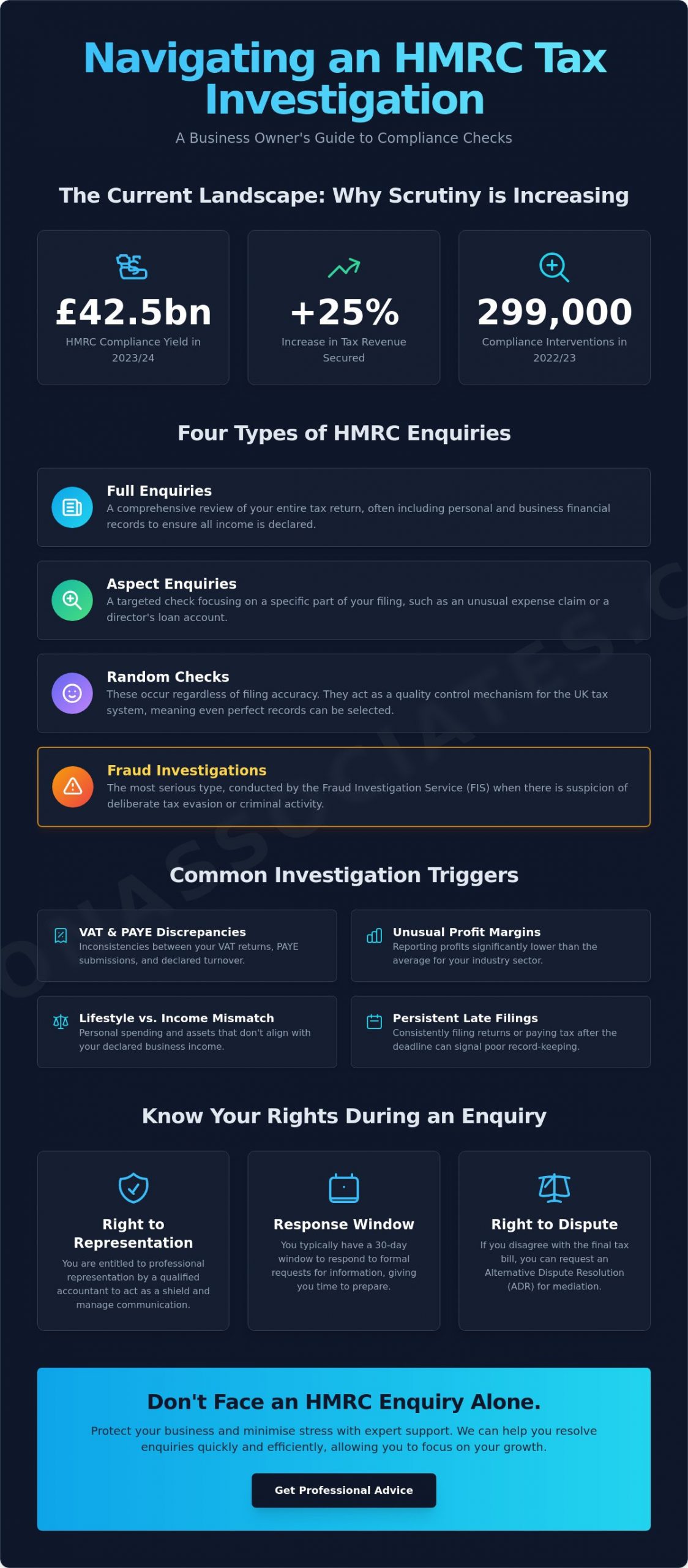
Did you know that HMRC’s compliance yield hit a record £42.5 billion in the 2023/24 tax year? This represents a significant 25% increase compared to previous periods, signalling that hmrc investigations are becoming more frequent and targeted as we head into 2026. We know that the arrival of an official enquiry letter often triggers immediate anxiety about financial penalties and the time lost from growing your firm.
It’s completely understandable to feel overwhelmed by the prospect of scrutiny, especially when your records aren’t as organised as you’d like. This guide provides the tools you need to handle an investigation with calm competence, shielding your business from avoidable fines. You’ll discover how to resolve enquiries quickly and minimise any tax owed, allowing you to move beyond the books and focus solely on your long term success.
Key Takeaways
- Learn why a tax compliance check is a formal review of your records rather than an accusation of fraudulent behaviour, allowing you to respond with calm competence.
- Identify the common triggers for hmrc investigations, such as VAT discrepancies, so you can proactively protect your business from unnecessary scrutiny.
- Understand the differences between full and aspect enquiries to determine the specific focus of HMRC’s review and prepare your documentation effectively.
- Discover the immediate steps to take upon receiving an enquiry letter, ensuring you have the professional representation needed to minimise stress and penalties.
- See how expert tax planning goes “beyond the books” to act as a shield for your business, letting you focus solely and truly on your growth goals.
Understanding HMRC Tax Investigations: Why Your Business Might Be Under Review
Have you opened your post to find a formal letter from the tax office and felt a sudden wave of anxiety? You’re not alone. Every year, thousands of UK entrepreneurs face hmrc investigations, but it’s vital to remember that a compliance check isn’t an accusation of fraud. It’s a formal review of your financial records to ensure the national treasury receives the correct amount of tax. During the 2022/23 financial year, HMRC conducted approximately 299,000 compliance interventions to secure £34 billion in tax revenue that might otherwise have gone unpaid.
Understanding What is a Tax Investigation helps demystify the process. HMRC isn’t necessarily hunting for hidden accounts; they’re often just verifying that the figures in your returns match the reality of your bank statements. Being transparent and cooperative from the very start is your best defence. When you provide clear, well-organised data, you demonstrate professional competence and integrity. This proactive approach allows you to resolve the matter quickly so you can focus solely and truly on your goals.
The Scope of a Compliance Check
HMRC’s reach is comprehensive and detailed. They’ll look at your Self-Assessment or Corporation Tax returns to ensure profit declarations are accurate. They also examine VAT records and PAYE submissions to confirm that employee taxes and National Insurance contributions are being handled correctly. HMRC uses advanced “Connect” software to compare your accounts against industry benchmarks. If your business reports a 15% profit margin whilst your competitors in the same sector average 35%, this inconsistency might trigger a review. They also look for lifestyle mismatches, checking if your personal spending aligns with your declared business income.
Your Rights During an Enquiry
You have specific protections throughout this process. You’re entitled to professional representation by a qualified accountant who can act as a shield between you and the tax office. This partnership goes beyond the books, as it relieves you of the technical complication and ensures your interests are protected. You typically have a 30-day window to respond to any formal request for information. If a disagreement persists regarding the final bill, you have the right to request an Alternative Dispute Resolution (ADR). This allows an impartial HMRC officer to mediate the case, often preventing the need for a costly tax tribunal. Knowing these rights helps you stay calm, confident, and in control.
The Different Types of HMRC Compliance Checks and Enquiries
Have you ever opened a letter from the tax office and felt an immediate sense of unease? It’s a common reaction for small business owners across the UK. Understanding the specific nature of HMRC tax compliance checks is the first step toward regaining your peace of mind. HMRC doesn’t treat every query the same way; their approach varies based on what their systems have spotted in your records.
There are four primary ways the tax office might engage with your business:
- Full Enquiries: These are comprehensive reviews where HMRC examines the entire tax return. For sole traders, this often includes a look at personal financial records to ensure all income is declared.
- Aspect Enquiries: These focus on one specific part of your filing, such as a particular expense claim or a director’s loan account.
- Random Checks: These occur regardless of your filing accuracy. They act as a quality control mechanism for the UK tax system.
- Fraud Investigations: These are the most serious hmrc investigations, conducted by the Fraud Investigation Service (FIS) when they suspect deliberate tax evasion or criminal activity.
Aspect vs. Full Enquiries
Why are aspect enquiries so common for smaller firms? Usually, it’s because a single figure looks out of place compared to industry benchmarks. If your travel expenses suddenly spike by 300% without a rise in turnover, it might trigger a query. Whilst these are narrow in scope, they can escalate quickly if your records are poor. If you cannot justify a specific “aspect,” the investigator may decide to broaden the scope into a full enquiry to see what else might be missing. We often find that keeping real-time records helps businesses resolve these checks before they grow into something more complex.
The Reality of Random Selection
It’s a misconception that only “dodgy” businesses get audited. HMRC uses a sophisticated data-mining software called “Connect” to cross-reference billions of data points from banks, the Land Registry, and even social media. In the 2022/23 tax year, HMRC’s compliance activities generated £34 billion in additional revenue, proving how effective their digital targeting has become. Even a perfect tax return can be selected for a check. These random audits ensure that the system remains fair and that everyone is contributing their correct share.
At Season Associates, we aim to look “beyond the books” to protect your hard work. If you want to ensure your filings are robust enough to withstand any scrutiny, we can help you organise your tax affairs so you can focus solely and truly on your goals. Our proactive approach acts as a shield, providing the calm competence you need to flourish without the fear of unexpected hmrc investigations.
Common Triggers: Why HMRC Chooses Certain Returns for Closer Inspection
Have you ever wondered why some businesses seem to coast along whilst others face constant scrutiny? It’s a common misconception that hmrc investigations are purely random. In reality, the tax office uses a sophisticated risk-based approach to decide who to audit. If your VAT returns show high input tax claims that don’t align with the turnover in your annual accounts, you’re likely to flag up on their system. These discrepancies often suggest that either income is being suppressed or expenses are being inflated.
Profit margins provide another vital clue. HMRC holds vast amounts of data on sector-specific benchmarks. If you run a consultancy business with a 10% profit margin whilst the industry average sits at 30%, it raises questions about your business costs. According to FSB’s complete guide to HMRC enquiries, even simple, recurring mistakes in your filings can lead to a more intrusive look into your financial history. HMRC remembers past errors; if you’ve been caught out before, they’ll likely monitor your future submissions with a sharper eye.
Omission of income is perhaps the most serious trigger. This includes:
- Failing to declare rental income from a second property.
- Overlooking interest earned on offshore bank accounts.
- Neglecting to report capital gains from the sale of digital assets or shares.
The “Connect” Computer System
HMRC’s primary weapon is “Connect,” an £80 million analytical database that cross-references data from over 30 different sources. It pulls information from banks, the Land Registry, DVLA records, and even social media to build a profile of your lifestyle and spending. Since the phased introduction of Making Tax Digital (MTD) in April 2019, HMRC now receives your data in real-time. This digital shift is actually a benefit for the organised business owner. By using cloud-based software, you reduce the likelihood of manual intervention because your records are transparent, accurate, and harder to dispute.
Industry-Specific Risk Factors
Certain sectors naturally attract more attention. High-cash businesses such as takeaways, hair salons, and taxi firms are frequently targeted because the potential for “off-the-books” transactions is higher. HMRC also launches specific “Campaigns” to recover unpaid tax from targeted professions, such as the healthcare or legal sectors. At Season Associates, we go beyond the books to monitor these shifting trends. We act as a diligent guardian for our clients, ensuring your records are robust enough to withstand any challenge. Our proactive approach relieves you of these complications, allowing you to focus solely and truly on your goals whilst we handle the technical shield of your business.
How to Organise and Prepare for a Tax Investigation Visit
Are you feeling overwhelmed by the prospect of a face-to-face meeting with a tax inspector? It is a common reaction amongst business owners, but your preparation determines the outcome. During the 2022/23 tax year, HMRC opened 299,000 compliance checks, proving that hmrc investigations are a standard part of the UK tax landscape. To protect your business, you must move from a state of uncertainty to one of calm competence by following these five steps.
- Step 1: Review the HMRC letter carefully. Identify whether the enquiry is a “full” enquiry into every aspect of your return or an “aspect” enquiry focused on a specific area, such as your VAT or Corporation Tax.
- Step 2: Notify your accountant immediately. Professional representation is not just helpful; it is essential. Your accountant acts as a diligent guardian, ensuring HMRC does not overstep its statutory powers.
- Step 3: Conduct a self-audit. Review your records for the period in question before the meeting. If you identify a mistake, disclosing it voluntarily before HMRC finds it can lead to significantly lower penalties under the Finance Act 2007.
- Step 4: Gather all relevant records. Organise your receipts, invoices, and bank statements chronologically. Having a clear audit trail demonstrates that you take your compliance seriously.
- Step 5: Decide on a neutral location. You aren’t required to host the meeting at your home or business premises. Choosing your accountant’s office provides a professional buffer and keeps the focus strictly on the records.
Document Management and Cloud Accounting
Modern record-keeping is your best defence during hmrc investigations. By using cloud-based systems like Xero or QuickBooks, you can retrieve any transaction with just a click of your finger. This transparency builds immediate trust with the inspector. If your records are incomplete, HMRC may resort to a “best judgement” assessment. This means they estimate your tax liability based on their own calculations, which often results in a much higher bill than if you had accurate data to hand.
Conducting the Meeting with HMRC
The rhythm of the meeting should be steady and factual. It’s vital to remain polite whilst remaining focused solely on the questions asked. Never volunteer information that hasn’t been requested, as this can inadvertently open new lines of enquiry. Your accountant should act as the primary spokesperson, translating technical queries and ensuring the conversation stays within the agreed scope. This partnership allows you to focus on your business goals whilst your representative handles the complexities of the tax code.
Don’t face the taxman alone; let our experts provide the professional representation you need to defend your business during an HMRC investigation.
Beyond the Books: How Professional Support Minimises Investigation Stress
How do you feel when an official brown envelope from HMRC arrives on your desk? For many of the 5.5 million small businesses operating across the UK, that letter triggers immediate anxiety. Season Associates acts as your dedicated shield, stepping firmly between your business and the tax authorities. We handle the technical jargon and the rigorous demands of hmrc investigations so you don’t have to. Our strategy relies on detailed tax planning; by identifying potential red flags in your Corporation Tax or VAT returns before they’re even submitted, we often stop enquiries before they can start. If an honest error is found, we advise on voluntary disclosure. This proactive transparency is vital, as HMRC’s compliance handbook suggests that “unprompted” disclosures can lead to a 100% reduction in certain penalty types.
Our Proactive Approach to Compliance
We don’t just see you once a year at tax time. Our team monitors your records throughout the twelve-month cycle to ensure every entry is accurate and defensible. We provide this support with a “no hidden charges” guarantee, giving you predictable costs and total peace of mind. When an enquiry does occur, we take the lead. We manage every letter, phone call, and meeting with HMRC on your behalf. This allows you to step back from the conflict and focus solely and truly on your business goals. Our role is to relieve you of the complication, providing a calm, competent presence during a high-stakes period.
Turning a Challenge into a Growth Opportunity
An audit doesn’t have to be a dead end; it can be a catalyst for improvement. We use the findings from hmrc investigations to overhaul your future bookkeeping, turning a stressful event into a blueprint for better financial health. Since April 2022, nearly all VAT-registered businesses have been required to follow Making Tax Digital (MTD) rules. We ensure your systems aren’t just compliant for today, but are robust enough for the long term. By moving your accounts to modern, cloud-based systems, we provide real-time information that helps your business flourish. We believe in moving beyond the books to act as your business enabler, ensuring you stay organized and detail-oriented.
Don’t let tax complexities hold your potential back. Get professional HMRC investigation support today and let our diligent guardians protect your hard-earned success while you focus on what you do best.
Protect Your Growth and Achieve Peace of Mind
Navigating the complexities of tax compliance in 2026 requires more than just basic record-keeping. HMRC now employs sophisticated data-matching technology to identify potential errors, making it essential for you to maintain real-time accuracy. By adopting cloud-based accounting and preparing your documentation well in advance, you can significantly reduce the risks associated with a compliance check. You’ve worked hard to build your enterprise; don’t let a lack of preparation put your success at risk.
At Season Associates, we’ve spent over 10 years helping small businesses manage hmrc investigations with calm competence. Our team specialises in cloud-based systems like Xero and QuickBooks to ensure your data is always precise and accessible. We offer transparent, fixed-fee monthly support with no hidden charges, providing a reliable shield against the stress of financial enquiries. We go beyond the books to handle the technical hurdles, so you can focus solely and truly on your goals. Contact Season Associates for expert tax investigation advice today. With the right partner by your side, you can face the future with confidence and watch your business flourish.
Frequently Asked Questions
Is an HMRC investigation a random check or have I been targeted?
HMRC uses a combination of random sampling and risk-based targeting to select businesses for enquiry. Their sophisticated Connect AI system currently cross-references over 30 separate databases to identify inconsistencies in reported income. Whilst some checks are purely random to ensure general compliance, approximately 90% of enquiries are triggered by specific data anomalies or discrepancies. If you’ve received a notice, it’s often because their software has flagged a potential issue that requires clarification.
How far back can HMRC go in an investigation of my records?
HMRC can look back 4 years for innocent errors, but this window extends if they suspect negligence or fraud. For careless mistakes, the statutory limit is 6 years from the end of the relevant tax period. If they find evidence of deliberate tax evasion, the investigation can span 20 years of financial history. Keeping accurate records for at least 6 years ensures you’re prepared for most standard hmrc investigations and can provide the necessary evidence quickly.
What happens if I make an honest mistake on my tax return?
You’ll likely face a penalty based on a percentage of the “potential lost revenue,” but HMRC distinguishes between “reasonable care” and “deliberate” errors. If you show you took reasonable care, the penalty can be 0%. However, careless inaccuracies often attract fines between 15% and 30% of the unpaid tax. Being proactive and disclosing the error before they find it leads to significantly reduced penalties, helping your business continue to flourish without unnecessary financial strain.
How long does a typical HMRC investigation take to resolve?
Most simple compliance checks wrap up within 3 to 6 months, though complex cases can last over 18 months. The duration depends heavily on how quickly you provide requested documents and the depth of the enquiry. By using real-time information from systems like Xero or QuickBooks, you can often shorten this timeline. Our goal is to handle the heavy lifting so you can focus solely and truly on your goals whilst we manage the clock.
Can HMRC check my personal bank account during a business enquiry?
HMRC has the legal power to request personal bank statements if they believe business transactions are being filtered through private accounts. Under Schedule 36 of the Finance Act 2008, they can issue an information notice to access these records. This usually happens when business drawings don’t appear to support your lifestyle or if there’s a lack of clear separation between personal and professional finances. We help you maintain this vital boundary to protect your privacy.
Do I really need an accountant for a simple HMRC compliance check?
While not legally required, having a professional manage hmrc investigations prevents small queries from spiralling into costly full-scale audits. An accountant acts as your diligent guardian, ensuring you don’t provide more information than is legally necessary. We offer expert support with no hidden charges, providing the calm competence needed to resolve checks efficiently. This support allows you to move beyond the books and get back to growing your company with total peace of mind.