
Tax Return United Kingdom: The Complete Guide to Filing and Optimising for 2026
Did you know that HMRC issued roughly 1.1 million late-filing penalties for the 2022-23 tax year? It’s a staggering figure that highlights how easy it is to trip up on complex regulations whilst you’re busy trying to make your business flourish. Are you worried that a simple bookkeeping error could lead to an expensive investigation? We understand that managing your tax return united kingdom often feels like a burden that pulls you away from your true passion. You shouldn’t have to choose between growing your company and staying compliant with ever-changing HMRC rules.
We’ve designed this guide to help you master the filing process by providing expert insights on allowable expenses and professional strategies that ensure total compliance. You’ll discover how to transform a stressful annual chore into a streamlined, digital process that actually saves you money. From understanding the 31 January 2026 deadline to implementing real-time recording through tools like QuickBooks, we’ll go beyond the books to ensure you can focus solely and truly on your goals with total peace of mind.
Key Takeaways
- Navigate the Self-Assessment system with confidence by understanding exactly how HMRC collects Income Tax and National Insurance from your earnings.
- Identify if you are legally required to file a tax return united kingdom, specifically covering the criteria for sole traders and those with high annual incomes.
- Protect your hard-earned revenue by learning how to avoid the immediate £100 late-filing penalty and escalating interest charges that accrue after three months.
- Maximise your profitability by mastering the “wholly and exclusively” rule to claim legitimate business expenses, including simplified methods for home office costs.
- Discover how a “beyond the books” approach provides a protective shield for your business, offering fixed-fee support that allows you to focus solely on your goals.
Understanding the UK Tax Return System and HMRC Compliance
Are you feeling slightly overwhelmed by the prospect of filing your tax return united kingdom? You aren’t alone; for the 2022/23 tax year, over 12.1 million people were required to submit a Self-Assessment return. This system is the primary mechanism HMRC uses to collect Income Tax that isn’t automatically deducted from wages. Whilst employees often pay through PAYE, sole traders, partners, and those with diverse income streams must take proactive responsibility for their own reporting.
A clear Understanding the UK Tax Return System starts with distinguishing between your various liabilities. Income Tax is a levy on your personal earnings, whereas National Insurance contributions specifically build your entitlement to certain state benefits and the State Pension. If you’ve chosen to operate as a limited company, your business will instead pay Corporation Tax on its annual profits. At Season Associates, we aim for calm competence, helping you navigate these distinctions so you can focus solely and truly on your goals.
The UK tax year follows a specific cycle, running from 6 April to 5 April. This unusual timeline dates back to the calendar reforms of 1752 and dictates every filing deadline you’ll face. To communicate with HMRC effectively, you must have a Unique Taxpayer Reference (UTR). This 10-digit number acts as your permanent identifier; it’s essential for everything from registering for tax return united kingdom services to claiming tax reliefs. Without it, you cannot file, which could lead to an immediate £100 penalty if you miss the 31 January digital deadline.
Key Tax Return Forms: SA100 vs CT600
The SA100 is the standard form for individuals and sole traders to report their personal income. If your financial life is more complex, you’ll need supplementary pages; for example, the SA105 for UK property income or the SA108 for Capital Gains. Conversely, limited companies must file a CT600. This form is more technical, as it must align perfectly with your statutory accounts to show how your taxable profit was calculated after all allowable expenses were deducted.
The Shift to Digital: HMRC’s Modernisation
HMRC is moving beyond the books by encouraging taxpayers to use the Personal Tax Account. This digital hub allows you to manage your affairs with just a click of your finger, providing real-time information that helps prevent nasty surprises at the end of the year. By monitoring records closely, you can see your tax position as it evolves rather than waiting for a final bill. For the 2026 tax year, the Self-Assessment system is defined as a mandatory digital reporting framework requiring quarterly updates for most self-employed individuals and landlords under the Making Tax Digital initiative.
Who Must File a Self-Assessment Tax Return?
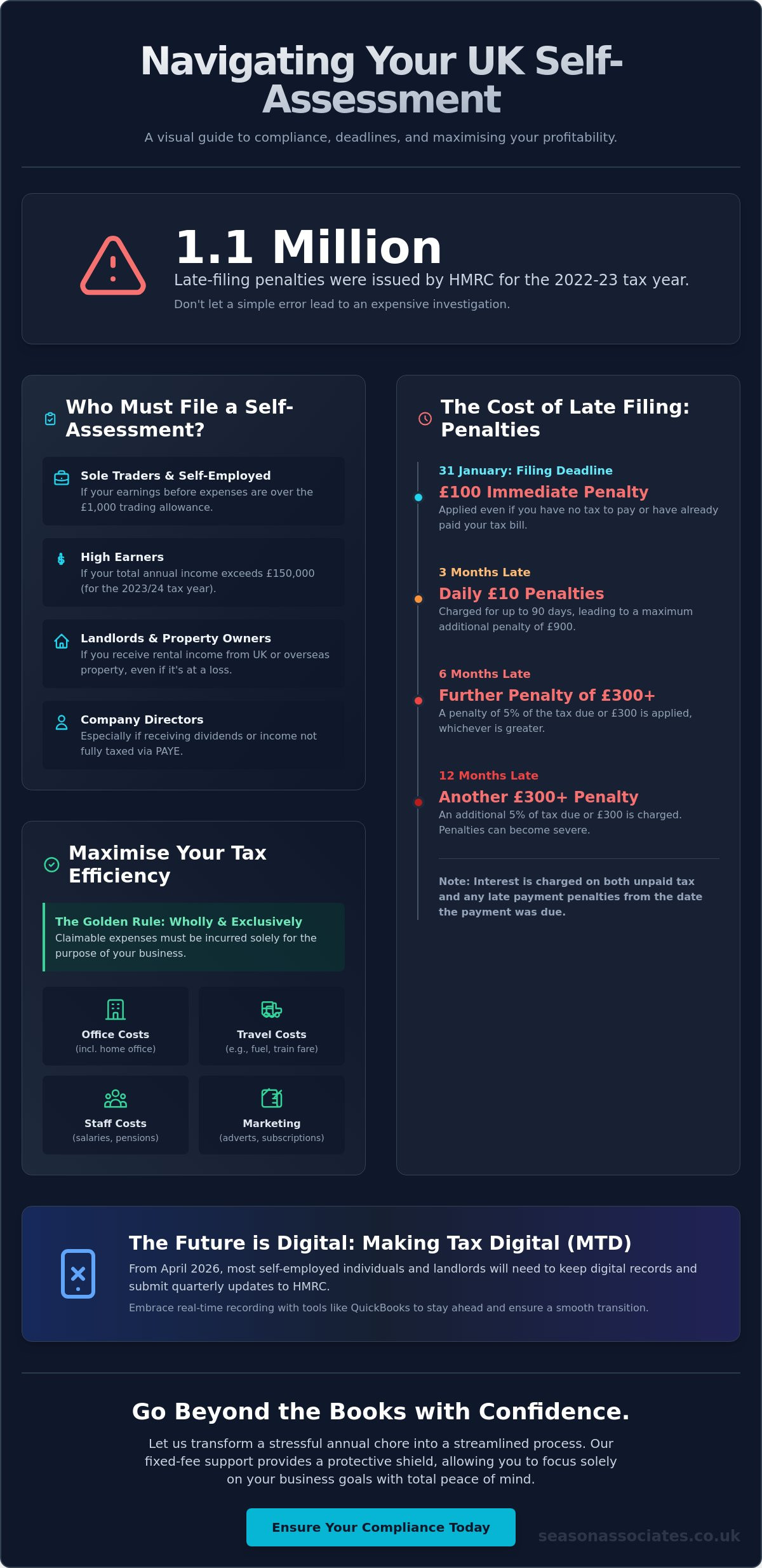
Are you wondering if your current income streams trigger a formal declaration to HMRC? Understanding exactly who needs to submit a tax return united kingdom is the first step toward avoiding unnecessary penalties and gaining peace of mind. For the 2023/24 tax year, the rules have evolved significantly. If your total annual income exceeds £150,000, you’re now required to file; this is a shift from the previous £100,000 threshold that applied to the 2022/23 period. Sole traders earning more than £1,000 before expenses must also register to stay compliant. This trading allowance is a vital starting point for micro-businesses and side hustles alike.
Landlords receiving rental income from UK or overseas property must report these figures, even if the property is currently operating at a loss. Company directors often find themselves in this category too, particularly when receiving dividends or managing complex income structures that aren’t fully captured through PAYE. By Maximising Tax Efficiency and Allowable Expenses, you can ensure you’re only paying what you truly owe. If these rules feel overwhelming, our team at Season Associates relieves you with all the complication so you can focus solely and truly on your goals.
Specialised Sectors: CIS and Contractors
Are you working in construction? Subcontractors under the Construction Industry Scheme (CIS) often face a 20% flat-rate deduction from their pay. Because this doesn’t account for your tax-free personal allowance, many workers are entitled to significant refunds at the end of the year. Filing a tax return united kingdom is the only way to reclaim this overpaid tax. For private sector contractors, managing IR35 status remains a top priority. You must ensure your records reflect your true employment status to prevent HMRC from reclassifying your income and applying backdated charges. We provide a reliable shield against these complications by monitoring records closely.
Trusts, Estates, and High Net Worth Individuals
Filing requirements extend far beyond active employment. Trustees and executors of deceased estates must manage specific tax obligations to ensure legal compliance during difficult times. If you’ve sold a secondary residence or shares, you’ll likely need to report Capital Gains Tax. This is especially urgent for UK residential property sales, which require reporting and payment within 60 days of completion. High net worth individuals must also stay alert to the upcoming “non-dom” status changes announced in the 2024 Spring Budget. Reporting foreign income accurately is essential as the UK moves toward a residence-based system. We look beyond the books to provide detailed tax planning that helps you flourish whilst keeping your records accurate.
Common Pitfalls and HMRC Penalties to Avoid
Have you ever felt that sinking feeling as a deadline looms? Missing the submission date for your tax return united kingdom triggers an immediate, non-negotiable £100 fine. This penalty applies even if you don’t owe any tax or have already paid your bill in full. If the delay stretches past three months, HMRC applies daily penalties of £10 for up to 90 days, potentially adding £900 to your bill. By the six-month mark, you’ll face an additional charge of £300 or 5% of the tax due, whichever is higher. These costs accumulate rapidly, turning a simple oversight into a significant financial burden.
HMRC maintains a strict stance on “careless” versus “deliberate” errors during their investigations. If an inquiry reveals that you failed to take reasonable care, penalties can range from 0% to 30% of the potential lost revenue. However, if they find an error was deliberate, those fines can soar to 100% of the tax owed. Many taxpayers attempt to appeal these charges by citing a “reasonable excuse.” In reality, HMRC rarely accepts excuses such as “the website was too complicated” or “my accountant let me down” without professional backing to prove you acted with due diligence. To stay compliant, you can follow this guide on How to complete a Self Assessment tax return to ensure every detail is captured correctly.
The Cost of Incorrect Data
Small inaccuracies often lead to substantial cash flow disruptions. Miscalculating “Payments on Account” is a frequent trap for the self-employed, as HMRC requires two advance payments each year based on your previous bill. If you fail to account for this, your January and July outgoings could be far higher than expected. It’s also vital to report every tax return united kingdom income stream, including small bank interest amounts or occasional side hustle earnings. HMRC’s “Connect” system cross-references data from banks and digital platforms, making it easy for them to spot omissions. You should avoid using “estimates” unless you’ve exhausted all options; if you must use one, you are legally required to flag it on the return to avoid accusations of negligence.
Missing Critical Deadlines
Staying ahead of the calendar is the best way to protect your profits. If you’re new to Self-Assessment, you must register by 5 October following the end of the tax year in which you started your business. Many people also confuse the two main filing dates. The deadline for paper returns is 31 October, while online submissions must be completed by 31 January. Using the wrong deadline for your filing method will result in an automatic penalty. Looking forward, the 2026 interest rates for late tax payments are expected to remain pegged at 2.5% above the Bank of England base rate, making late payments an increasingly expensive debt to carry. We act as your diligent guardian, monitoring these dates closely so you can focus solely on your professional goals.
Maximising Tax Efficiency and Allowable Expenses
Are you concerned that you’re paying more to HMRC than is strictly necessary? Understanding the nuances of allowable expenses is the most effective way to protect your hard-earned profits. Every pound you legitimately claim as a business expense reduces the profit figure used to calculate your tax return united kingdom, directly lowering your final bill.
HMRC operates under the strict “wholly and exclusively” rule. This means any cost you claim must be for the sole purpose of your trade. If an expense has a dual purpose, such as a laptop used for both client work and personal gaming, you must accurately apportion the cost. We find that many business owners miss out on significant savings simply because they lack a clear system for tracking these smaller, everyday costs.
- Home Office: If you work from home, you can use simplified flat-rate expenses. For 25 to 50 hours of business use per month, you can claim £10. This rises to £26 per month if you exceed 100 hours.
- Travel and Vehicles: You cannot claim for your daily commute to a permanent office. However, travel to temporary sites or client meetings is fully deductible. Using the 45p per mile rate for the first 10,000 miles is often the most straightforward method for vehicle claims.
- Pensions and Charity: Contributions to a registered pension scheme are highly tax-efficient. They effectively extend your basic rate tax band, which can prevent you from slipping into the 40% or 45% tax brackets.
Capital Allowances and R&D Credits
For larger investments, the Annual Investment Allowance (AIA) allows you to deduct the full cost of qualifying plant and machinery, up to a limit of £1 million, in the year of purchase. This is a powerful tool for businesses looking to upgrade technology or equipment. Additionally, despite the merging of R&D schemes in April 2024, small businesses engaged in genuine innovation can still access vital tax relief. We recommend maintaining a digital folder of invoices and project logs to support these high-value claims during an HMRC review.
Preparing for Making Tax Digital (MTD)
The days of paper ledgers are ending. From April 2026, self-employed individuals with qualifying income over £50,000 must comply with Making Tax Digital for Income Tax. By adopting cloud-based software like Xero, QuickBooks, or FreeAgent now, you gain real-time visibility of your finances. This technology allows you to see your tax liability with just a click of your finger, removing the traditional “January panic.” At Season Associates, we look beyond the books to help you transition to these modern systems seamlessly.
Our team acts as a diligent guardian for your finances, ensuring you never pay a penny more than required. Let us manage your tax return united kingdom so you can focus solely and truly on your goals.
Beyond the Books: How Season Associates Simplifies Your Tax
Are you feeling overwhelmed by the impending deadline for your tax return united kingdom? At Season Associates, we understand that the weight of HMRC compliance can often distract you from your core mission. We position ourselves as your “Diligent Guardian,” a role that goes far beyond the books to protect your business from unnecessary scrutiny. By monitoring your records closely throughout the financial year, we act as a proactive shield against the anxiety of potential audits and the sting of avoidable fines.
Our partnership is built on total transparency. We offer fixed-fee monthly retainers, ensuring you never encounter the frustration of surprise billing or hidden charges. This predictable structure allows you to budget with confidence while receiving year-round support. If you’ve ever worried about the complexity of Corporation Tax or Capital Gains Tax, our experts provide the “calm competence” needed to navigate these regulations. We handle the technicalities so you can focus solely and truly on your business goals.
- Detailed tax planning to minimise liabilities legally.
- Protection against HMRC tax investigations through rigorous record-keeping.
- Fixed monthly fees that provide peace of mind and better cash flow management.
- A dedicated partner who understands the unique pressures of UK small businesses.
Our Seamless Filing Process
We’ve modernised the accounting experience to fit your busy schedule. From your initial consultation to the final submission, the entire journey is designed to be effortless. You can approve your documents with just a click of your finger using our cloud-based systems. Our specialists don’t just tick boxes; they scrutinise every entry to identify missed relief opportunities that help your finances flourish. This ongoing support means we’re here for you every month, not just during the January rush.
Get Started with a Professional Tax Review
Why risk the stress of a mistake when professional oversight is so accessible? An error on your tax return united kingdom can lead to significant penalties, often starting at a £100 automatic fine for being just one day late. A professional review is almost always more affordable than the cost of a single filing error or an overlooked tax relief. We are currently inviting forward-thinking business owners to book a consultation and secure their 2026 filing slot. Take the first step toward financial clarity today.
Secure Your Financial Peace of Mind for 2026
Navigating your tax return united kingdom doesn’t have to be a source of annual anxiety. With HMRC applying immediate £100 penalties for late filings, staying ahead of the 31st January deadline is essential for protecting your hard-earned profits. You’ve now seen how identifying every allowable expense and utilising cloud-accounting tools like Xero or QuickBooks can transform a complex chore into a streamlined, efficient process.
At Season Associates, we go beyond the books to ensure your business continues to flourish. We bring over 10 years of HMRC compliance expertise to the table; we’re specialists in CIS and SME tax planning who keep your records accurate and your liabilities low. Why spend your weekends deciphering tax codes when you can leverage our status as cloud-accounting experts? We’ll manage the technicalities whilst you dedicate your energy to growth.
Focus on your goals and let us handle your UK tax return
Your success is our priority, and we’re ready to help you accomplish your 2026 financial targets with calm competence and total transparency. You’ve got the vision for your business, and we’re here to provide the steady support you need to reach it.
Frequently Asked Questions
When is the deadline for filing my 2025/2026 tax return in the UK?
The deadline for filing your 2025/2026 online tax return is 31 January 2027. If you prefer to submit a paper return, you must complete it by 31 October 2026. Missing these dates results in an immediate £100 penalty from HMRC. We recommend filing early to avoid the last-minute rush; this gives you a clear view of your liabilities well before the payment is due.
Can I file my own tax return or do I need a chartered accountant?
You aren’t legally required to hire a chartered accountant to file your tax return united kingdom, but doing so provides a protective shield against costly errors. While the HMRC portal is accessible, a professional ensures you claim every eligible relief and allowance. Our team handles the technical complexities so you can focus solely and truly on your business goals without worrying about a potential HMRC investigation.
What happens if I cannot afford to pay my tax bill by 31 January?
You should contact HMRC immediately to set up a “Time to Pay” arrangement if you can’t meet the 31 January deadline. This service is generally available if you owe £30,000 or less and don’t have other active payment plans. Acting quickly prevents the 5% late payment penalties that trigger at 30 days, 6 months, and 12 months. We help you navigate these negotiations to maintain your financial stability.
What are allowable expenses for a sole trader working from home?
You can claim a proportion of your household bills, including heating, electricity, council tax, and mortgage interest, based on the number of rooms used for work. Alternatively, HMRC allows a “simplified expenses” flat rate of £10 to £26 per month depending on how many hours you work from home. We’ll help you calculate which method yields the highest tax saving to ensure your business flourishes.
Do I need to file a tax return if I am an employee on PAYE?
You generally don’t need to file a return if your only income is through PAYE and is below £150,000. However, you must register for Self-Assessment if you have untaxed income over £1,000, such as from property rentals or dividends. If your circumstances change, we can review your records to ensure you stay compliant and avoid any unexpected “hidden charges” or fines from the tax office.
How long must I keep my financial records for HMRC purposes?
You must keep your financial records for at least five years after the 31 January submission deadline for each tax year. For the 2025/2026 period, this means holding onto your receipts, bank statements, and invoices until at least 31 January 2032. We advocate for using cloud-based systems like Xero or QuickBooks; this makes monitoring records closely a simple task that you can manage with just a click of your finger.
What is a “Payment on Account” and why is it so high?
A “Payment on Account” consists of two advance payments toward your next tax bill, each equalling 50% of your previous year’s total liability. These are due on 31 January and 31 July. The cost feels high because you’re paying for the current year whilst also settling the previous one. If you expect your income to fall, we can apply to reduce these payments to protect your cash flow.
Is there a difference between a British tax return and a Self-Assessment?
There is no functional difference; “Self-Assessment” is simply the official name for the tax return united kingdom system used by HMRC. It’s the process where you report your earnings and “self-assess” how much tax is due based on current rates. Our role is to go beyond the books, providing the calm competence you need to navigate this system accurately while minimising your overall tax burden.