

Corporation tax guide for small businesses: save and comply
Corporation tax is one of those subjects that can make even the most confident business owner feel uncertain. You know you need to get it right, but between changing rates, allowable expenses, and rules about associated companies, it is easy to feel overwhelmed. Miss a relief and you overpay. Make an error and HMRC may come knocking. This guide cuts through the complexity and gives you practical, straightforward guidance on what you owe, what you can deduct, and how to keep more of your hard-earned profit while staying fully compliant.
Table of Contents
- Who needs to pay corporation tax and when does it apply?
- Corporation tax rates, thresholds and key calculations
- Allowable expenses and the ‘wholly and exclusively’ principle
- Special cases: marginal relief and associated companies
- Beyond the basics: R&D tax relief and recent changes
- Why many small businesses overpay corporation tax—and how to get it right
- Get help with your corporation tax—from setup to savings
- Frequently asked questions
Key Takeaways
| Point | Details |
|---|---|
| Check your business type | Only limited companies and some organisations pay corporation tax—sole traders do not. |
| Understand current rates | Tax is 19% up to £50k profits, 25% above £250k, with marginal relief in between. |
| Claim eligible expenses | Deduct costs that are wholly and exclusively for business to reduce your tax bill. |
| Be aware of group rules | If you have associated companies, your profit thresholds may reduce and affect your rate. |
| Keep up with relief changes | Recent updates mean R&D tax credits have a new structure from April 2024. |
Who needs to pay corporation tax and when does it apply?
Not every business pays corporation tax. Understanding whether it applies to you is the first step, and getting this wrong from the start can cause serious problems down the line.
Corporation Tax applies to limited companies registered with Companies House, foreign companies with a UK branch or office, and some clubs or community groups if they have taxable profit. If you run your business as a sole trader or in a partnership, you pay income tax on your profits instead, not corporation tax. This is a common source of confusion, particularly for people who are transitioning from self-employment to running a limited company.
The key trigger points for corporation tax obligations include:
- Incorporating a limited company with Companies House and beginning to trade
- Generating taxable profits in any accounting period
- Opening a UK branch of a foreign company
- Receiving investment income or chargeable gains within the company
Once your company is active, you must register with HMRC for corporation tax within three months of starting to trade. Your company tax return, known as a CT600, is due 12 months after the end of your accounting period. However, the tax itself must be paid nine months and one day after the end of that period. So if your year end is 31 March, your tax payment is due by 1 January the following year, but the return is not due until 31 March. Missing the payment deadline triggers interest charges, and late returns attract automatic penalties starting at £100.
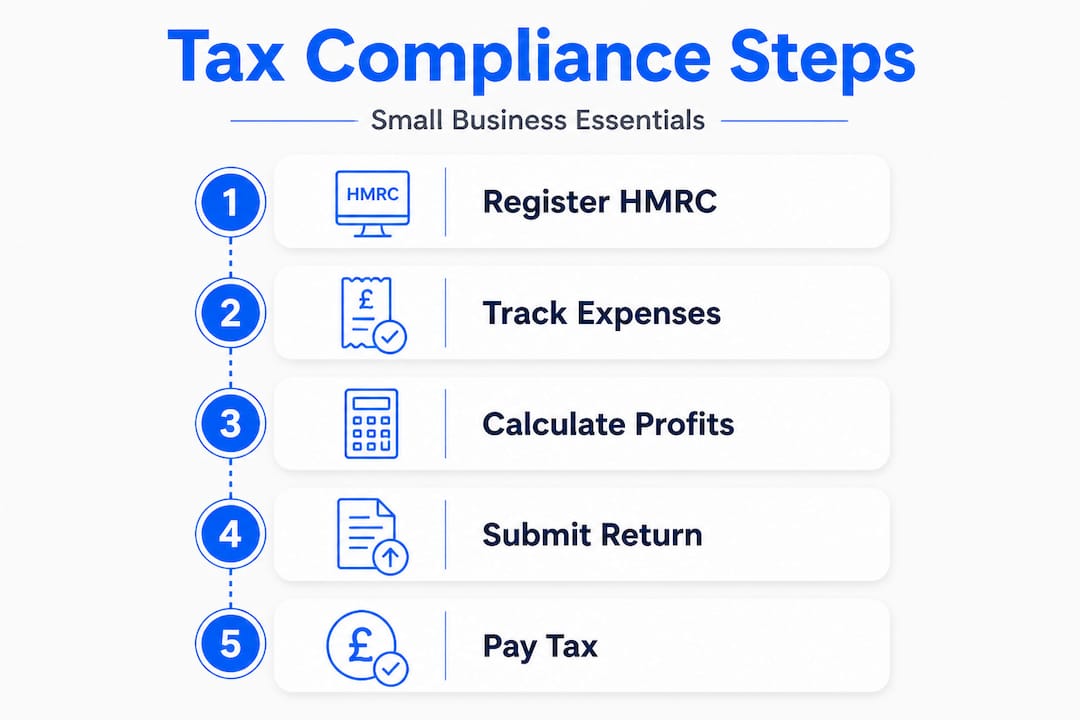
Understanding your corporation tax basics early means you can plan your cash flow accordingly and avoid nasty surprises. It also pays to keep your limited company accounts accurate and up to date throughout the year, rather than scrambling at the last minute.
Corporation tax rates, thresholds and key calculations
With the basics established, it is time to see what you will actually pay and how to work it out correctly.
The current rates, which have been in place since April 2023, are structured as follows:
| Profit level | Rate | Notes |
|---|---|---|
| Up to £50,000 | 19% (small profits rate) | Applies to the full profit |
| £50,001 to £250,000 | Marginal relief | Effective rate steps up gradually |
| Over £250,000 | 25% (main rate) | Applies to the full profit |
The corporation tax rates mean that a company with profits of £40,000 pays just 19%, while a company with profits of £300,000 pays 25% on the whole amount. The marginal relief band between £50,000 and £250,000 is where the calculation becomes more nuanced.
Here is a simple process for calculating your corporation tax liability:
- Start with your net profit as shown in your accounts.
- Add back any disallowed expenses such as client entertainment or depreciation.
- Deduct capital allowances for qualifying asset purchases.
- Apply the appropriate rate based on your adjusted profit figure.
- Apply marginal relief if your profits fall between £50,000 and £250,000.
- Deduct any reliefs such as R&D tax credits or losses brought forward.
Example: A company with adjusted profits of £80,000 does not simply pay 25%. Marginal relief reduces the effective rate, so the actual tax bill sits somewhere between the 19% and 25% rates. The formula for marginal relief is: (£250,000 minus your profits) multiplied by a fraction (currently 3/200). This reduces the tax calculated at 25%.
Pro Tip: If your profits are close to the £50,000 threshold, consider whether making additional pension contributions or bringing forward capital expenditure could keep you in the lower rate band. Even a modest reduction in taxable profit can save a meaningful amount of tax.
One point that catches many business owners off guard is the impact of associated companies. We will cover this in detail shortly, but be aware that having even one associated company halves both thresholds. This means the small profits rate applies only up to £25,000, not £50,000. Reviewing your tax return optimisation strategy with this in mind is essential.
Allowable expenses and the ‘wholly and exclusively’ principle
To reduce your tax, you need to know which expenses qualify and why accuracy here matters so much.

The rule is straightforward in principle: revenue expenses are deductible if they are not specifically disallowed and have only a business purpose. This is the “wholly and exclusively” test. In practice, however, it is where many small businesses either miss legitimate deductions or claim things they should not.
| Allowable expenses | Disallowed expenses |
|---|---|
| Staff salaries and employer’s NI | Client entertainment and hospitality |
| Office rent and business rates | Fines and penalties |
| Business travel and accommodation | Personal expenses |
| Professional subscriptions | Depreciation (use capital allowances instead) |
| Accountancy and legal fees | Dividends paid to shareholders |
| Business insurance | Political donations |
The tricky area is expenses that have a dual purpose. Take a mobile phone, for example. If you use it solely for business, the full cost is deductible. If you use it personally as well, only the business proportion can be claimed. The same logic applies to a vehicle used for both business trips and personal journeys. You must apportion the cost fairly and be able to justify that split if HMRC asks.
Travel expenses are another area worth examining carefully. Travel from your home to a regular workplace is not deductible. However, travel to a temporary workplace or to visit clients is generally allowable. Getting this wrong is a common mistake, particularly for directors who work from home but also visit an office.
The boundary between revenue and capital expenditure also matters. Revenue expenses, such as your monthly software subscription, are deducted in full in the year they arise. Capital expenses, such as purchasing a computer or a piece of machinery, are not deducted directly. Instead, you claim capital allowances, which spread the relief over time or, in many cases, allow a 100% deduction in year one through the Annual Investment Allowance.
Pro Tip: Keep a clear record of every business expense throughout the year, including receipts and a brief note of the business purpose. This not only supports your tax return but also protects you if HMRC queries a claim. Good records are your best defence, and they also help you spot expenses you might have missed. Staying on top of important tax deadlines alongside your bookkeeping makes the whole process far more manageable.
Special cases: marginal relief and associated companies
Even with rates in mind, associated companies can complicate matters, so here is how to handle it to avoid mistakes.
Two companies are associated if one controls the other, or if both are controlled by the same person or group of people. This includes companies controlled by close family members in many cases. The rules exist to prevent business owners from splitting profits across multiple companies to benefit from the lower rate multiple times.
Where a company has associated companies, the £50,000 and £250,000 limits are divided by the number of associated companies plus one. The limits are also proportionately reduced for accounting periods of less than 12 months.
Here is how this works in practice:
- Identify all associated companies, including those controlled by connected persons.
- Count the total number of associated companies and add one (for your own company).
- Divide both thresholds by that number to find your adjusted limits.
- Apply the correct rate using the adjusted thresholds, not the standard ones.
- Recalculate marginal relief using the reduced upper and lower limits.
For example, if you own two companies, your thresholds become £25,000 and £125,000. A company with profits of £60,000 that would normally fall in the marginal relief band now pays the full 25% rate because it exceeds the adjusted upper limit of £125,000 divided by two. Getting this wrong means either underpaying tax (which leads to interest and penalties) or overpaying unnecessarily.
Pro Tip: Review your group structure annually, particularly if you have set up new companies or if a family member has started a business. Changes in associated company status can shift your tax position significantly, and it is far better to identify this before filing than after. If you are concerned about HMRC investigation risks, getting the associated company rules right is one of the best ways to reduce your exposure.
Beyond the basics: R&D tax relief and recent changes
With core compliance handled, consider whether more advanced reliefs like R&D could help your business save further.
Research and development tax relief is one of the most valuable but underused reliefs available to UK companies. Many small business owners assume R&D relief is only for laboratories or technology firms, but it applies to a much wider range of activities. If your company has invested time or money in developing new products, processes, or software, or in improving existing ones, you may well qualify.
The key activities that can qualify include:
- Developing new or improved software systems
- Creating innovative manufacturing processes
- Designing products with new functionality or performance characteristics
- Overcoming technical uncertainties in a project, even if the project ultimately fails
From 1 April 2024, the landscape changed significantly. The previous SME and RDEC schemes were merged for most companies, simplifying the process and moving to an above-the-line mechanism. Under the merged scheme, the credit rate is 20% of qualifying R&D expenditure, and it appears as a credit in your profit and loss account before tax. This is a meaningful shift from the old SME scheme, which provided an enhanced deduction below the line.
The merged scheme also tightened the rules around subcontracted R&D and the use of overseas contractors. Costs for overseas workers are generally no longer qualifying unless there is a specific reason why the work could not be done in the UK.
Pro Tip: If you have never claimed R&D relief, it is worth reviewing your last two accounting periods, as claims can be made retrospectively. Work with an accountant who understands the post-2024 rules, as the merged scheme requires careful categorisation of qualifying costs. Using accounting technology for tax can help you track project costs throughout the year, making the R&D claim process much smoother.
Why many small businesses overpay corporation tax—and how to get it right
In our experience working with small businesses across the UK, the most common reason companies overpay corporation tax is not ignorance of the rules. It is a lack of time and structure to apply them properly.
The “wholly and exclusively” test sounds simple, but in practice, business owners often either claim too little (because they are not sure what qualifies) or claim items they should not (because they assume all business-related costs are deductible). Both outcomes cost you money. The first means you pay more tax than you should. The second means you face a potential HMRC enquiry and penalties.
Marginal relief is another area where we see real money left on the table. The calculation is not complicated, but it requires knowing your adjusted profit figure accurately before you can apply it. Many businesses file using rough estimates and then discover later that they either overpaid or underpaid. Neither is a good outcome.
The associated company rules trip up business owners who have grown organically, perhaps setting up a holding company, a property company, or a second trading entity over the years, without revisiting how this affects their tax thresholds. A group structure that made sense commercially can quietly push a company into the 25% rate without anyone noticing until the tax bill arrives.
R&D relief remains widely overlooked, even after the 2024 merger. We regularly see innovative small businesses that have never made a claim, simply because they did not realise their activities qualified. The merged scheme is more straightforward in some respects, but it still requires a proper review of qualifying costs and activities.
The practical steps that make the biggest difference are simple: conduct an annual tax review before your year end, not after. Work with an accountant who understands your business structure, not just your accounts. And use your filing and optimisation guide as a reference point throughout the year, rather than only when a deadline is approaching. Good tax planning is a habit, not a one-off event.
Get help with your corporation tax—from setup to savings
Getting corporation tax right takes time, knowledge, and attention to detail. Most small business owners have all three in short supply.
At Season Associates, we support small businesses and limited companies with everything from day-to-day bookkeeping and compliance through to year-end accounts, CT600 returns, and proactive tax planning. Whether you are just starting out and need help with limited company setup or you are an established business looking to reduce your tax bill legally and confidently, our team is here to help. Visit our small business accounting services page to find out how we can take the stress out of corporation tax and keep your business on solid financial ground.
Frequently asked questions
What is the corporation tax rate for small companies in 2026?
The corporation tax rate is 19% for profits up to £50,000, rising through marginal relief to 25% for profits over £250,000. Companies with profits between these figures pay an effective rate between 19% and 25%.
Can sole traders pay corporation tax?
No. Sole traders pay income tax on their profits through Self Assessment. Corporation tax applies only to limited companies and certain other organisations with taxable profit.
What expenses can I deduct before calculating corporation tax?
You can deduct expenses wholly and exclusively for business purposes, provided they are not specifically disallowed by HMRC. If an expense has both business and personal elements, only the business portion qualifies.
How do associated companies affect my tax thresholds?
Profit limits are divided by the number of associated companies plus one, which can significantly lower the thresholds at which higher rates apply. This means a company with one associate faces a small profits threshold of £25,000 rather than £50,000.
Has R&D tax relief changed for small businesses?
Yes. From 1 April 2024, the SME and RDEC schemes merged for most companies, creating a single above-the-line credit at 20% of qualifying expenditure. The rules around overseas contractors and subcontracted work have also tightened under the new scheme.


https://shorturl.fm/AWmZP
https://shorturl.fm/mznsO
https://shorturl.fm/xYRbP