
HMRC Personal Tax Account: The Complete Guide for UK Taxpayers in 2026
Did you know that over 7.18 million UK taxpayers now manage their finances through a screen, with HMRC app logins surging by 20% in the last year alone? Whilst the shift toward a digital-first system is accelerating, we understand that staring at a login screen can often feel more like a barrier than a benefit. You might feel a lingering anxiety regarding an incorrect tax code or find the process of proving your identity online to be a frustrating hurdle. Your personal tax account should be a tool for clarity, not a source of stress that keeps you awake at night.
We believe that mastering your digital relationship with the Revenue is the first step toward professional freedom. This guide will help you navigate the 2026/27 tax year with confidence, ensuring you understand the £12,570 personal allowance and the new Making Tax Digital requirements for those earning over £50,000. We will walk you through the setup process, explain how to monitor your National Insurance record, and show you how to track refunds with total peace of mind. Let’s move beyond the books and secure your financial future with just a click of your finger.
Key Takeaways
- Master the setup of your Government Gateway ID by following a structured identity checklist to ensure a seamless and secure connection to HMRC.
- Use your personal tax account as a real-time financial dashboard to verify your tax code accuracy and claim overpaid tax through the digital P800 process.
- Gain total clarity on your income across all sources to optimise your strategic tax planning, particularly when balancing dividends and salary distributions.
- Prepare for the 2026 transition to a digital-first system and learn how to stay compliant with the evolving Making Tax Digital (MTD) requirements.
- Discover how to look beyond the books by leveraging your account data for proactive tax planning and identifying potential R&D tax relief opportunities.
What is the HMRC Personal Tax Account and Why Does it Matter?
Have you ever felt a sense of dread when a brown envelope from the tax office lands on your doormat? The personal tax account was designed to replace that uncertainty with a sense of calm competence. It serves as a secure, centralised digital hub where UK residents can oversee their financial obligations and entitlements in real time. Rather than waiting weeks for a letter, you can access your data with just a click of your finger, ensuring you stay ahead of deadlines and avoid the risk of penalties. This platform is the cornerstone of the modern relationship between taxpayers and HM Revenue and Customs (HMRC), acting as a reliable shield against the complications of traditional paperwork.
It’s vital to distinguish this from a Business Tax Account. Whilst a company director uses a business account to manage Corporation Tax or VAT, their individual salary, dividends, and National Insurance contributions are housed within the personal tax account. Understanding this distinction is the first step toward detailed tax planning. When you can see your total income across all sources in one place, you gain the power to make informed decisions about your financial future. This transparency relieves you of the complications that arise from fragmented records and provides a clear path toward your professional goals.
The Shift Towards a Paperless HMRC
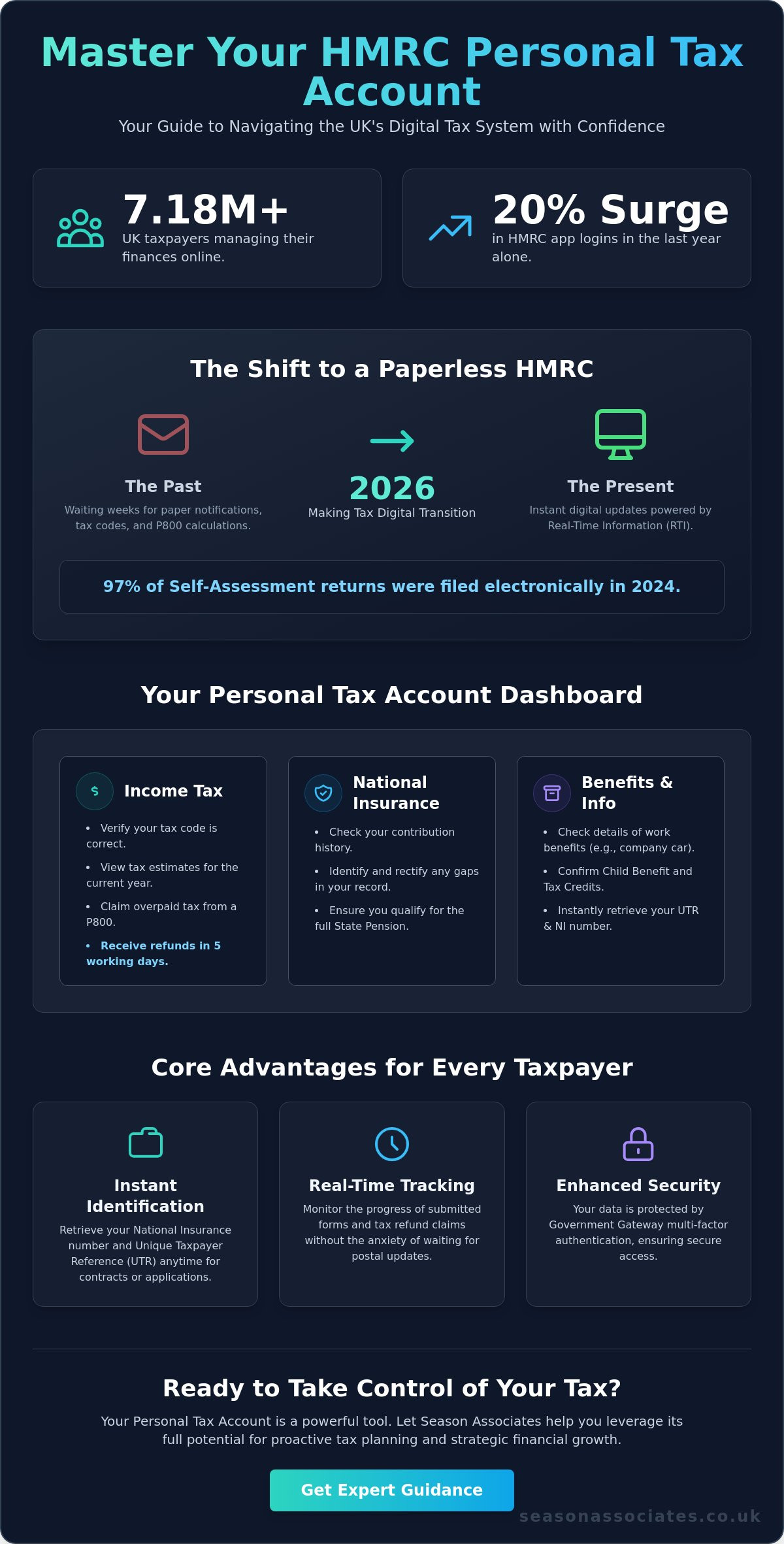
In 2026, the transition to digital by default has reached a pivotal milestone. HMRC is phasing out traditional paper notifications, such as P800 tax calculations and paper-based tax code changes, in favour of instant digital updates. This shift is powered by Real-Time Information (RTI), which ensures your tax records reflect your current earnings almost immediately. With 97% of Self-Assessment returns now filed electronically as of 2024, the move toward a paperless system is no longer a future goal but a present reality for every UK taxpayer. This evolution ensures that your records are accurate, up to date, and easily accessible whenever you need them.
Key Benefits for the Modern Taxpayer
Security and accessibility are the primary drivers of this digital evolution. Your account provides immediate access to essential data that used to require lengthy phone calls or postal requests. By centralising your information, HMRC has made it easier for you to manage your affairs without the traditional administrative burden.
- Instant Identification: Retrieve your National Insurance number and Unique Taxpayer Reference (UTR) whenever you need them for mortgage applications or new contracts.
- Real-Time Tracking: Monitor the progress of forms you’ve submitted or claims for tax refunds without the anxiety of waiting for postal updates.
- Enhanced Security: Your financial data is protected by Government Gateway multi-factor authentication, ensuring that only you can access your sensitive records.
By embracing these tools, you allow yourself to focus solely and truly on your goals, knowing your compliance is handled with precision and care. This proactive approach to managing your tax affairs ensures that you are never caught off guard by unexpected changes or requirements.
Navigating Key Features: Managing Your Income and Benefits
Once you Set up your HMRC Personal Tax Account, the personal tax account dashboard becomes your primary tool for financial oversight. The “Income Tax” section is perhaps the most critical area for any employee or director. Here, you can view your tax code and an estimate of the tax you’ll pay for the current year. If you’ve overpaid tax, HMRC often issues a P800 calculation. Instead of waiting for a cheque in the post, you can submit your bank details directly through the portal to receive your refund within five working days. This direct approach eliminates the uncertainty that often accompanies tax season and puts you back in control of your cash flow.
Monitoring your National Insurance (NI) contributions is equally vital for securing your long-term future. Many taxpayers are unaware of gaps in their record until it’s too late to rectify them. By checking your NI history regularly, you ensure that every year of work counts toward your State Pension. If you receive benefits from work, such as a company car or private medical insurance, these are also detailed here. Ensuring these figures match your P11D form is essential; even a small discrepancy can lead to an incorrect tax code and an unexpected bill. If these technical details feel overwhelming, our team at Season Associates can help you reconcile your records to ensure total accuracy.
Understanding Your Tax Code and RTI
Your tax code, commonly 1257L for the 2026/27 tax year, determines how much tax-free income you receive. Real-Time Information (RTI) means your employer sends your pay details to HMRC every time you’re paid. You should compare the “income from work” section against your actual payslips at least once a quarter. If your circumstances change, such as starting a new job or receiving a bonus, updating HMRC immediately through your personal tax account prevents the stress of a year-end adjustment. This proactive habit acts as a shield against the anxiety of hidden tax debts.
Managing State Benefits and Marriage Allowance
The portal also simplifies the management of family-related tax matters. If your earnings cross specific thresholds, you can track your Child Benefit and manage the High Income Child Benefit Charge (HICBC) to avoid penalties. For couples, the Marriage Allowance section allows you to transfer a portion of your personal allowance to a spouse or civil partner, which could reduce your collective tax bill by up to £252 per year. Finally, checking your State Pension forecast provides a clear picture of your retirement timeline, allowing you to identify opportunities for voluntary contributions if you have missing years in your record.
The Strategic Advantage: Using Your Account for Tax Planning
Do you view your tax portal as a simple filing cabinet or a high-performance dashboard? Most taxpayers treat the personal tax account as a place to visit once a year, yet its true value lies in proactive, real-time data analysis. By viewing your ‘Total Income’ from all sources, including salary and dividends, you can make informed decisions before the tax year ends on 5 April. For instance, if your combined income is nearing the £50,271 higher-rate threshold, you might choose to defer a dividend payment to remain within the basic rate band. This level of foresight transforms you from a passive participant into a strategic architect of your own wealth.
Accessibility is another major advantage for those planning significant life changes. If you’re applying for a mortgage, lenders often require an SA302 or a detailed history of your earnings. The HMRC Personal Tax Account offers a comprehensive five-year history of your income and tax paid. Having this information available with just a click of your finger simplifies the application process and provides the ‘calm competence’ needed to secure your property goals without administrative delays. This historical view is also an invaluable tool for identifying trends in your earnings that may influence your long-term pension contributions.
Identifying Errors Before They Become Penalties
Discrepancies often creep into records when employers submit Real-Time Information (RTI) that doesn’t quite align with your actual take-home pay. You might also spot ‘duplicate’ employments, a common occurrence when you change jobs and the previous employer fails to close your record correctly. If left uncorrected, these errors can lead to a split tax code, resulting in significant underpayments and eventual fines. Acting as a diligent guardian of your own data by checking your account monthly ensures these small glitches don’t spiral into a full HMRC investigation. It’s about catching the spark before it becomes a fire.
Preparing for Self-Assessment
For the self-employed, the portal is an essential staging area for the January filing deadline. You can easily retrieve your Unique Taxpayer Reference (UTR) and review previous returns to ensure consistency. It’s also the best place to track your payments on account, which are due by midnight on 31 January and 31 July. As we move into the 2026 tax year, the account integrates even more closely with Making Tax Digital (MTD) requirements for those with income over £50,000. Staying organised through the portal helps you manage cash flow effectively and keeps you focused solely and truly on your business growth.
Setting Up and Troubleshooting Your Digital Tax Identity
Setting up your personal tax account shouldn’t feel like an obstacle course. By approaching the process with calm competence, you can establish your digital presence in minutes rather than hours. The key is preparation. Before you even open the browser, gather your ‘Identity Checklist’ to ensure you don’t get timed out whilst searching for files. You’ll typically need your National Insurance number, a valid UK passport, a P60 from your employer, or a UK driving licence. Having these documents to hand acts as your first line of defence against setup frustration.
What happens if the system claims it ‘cannot verify your identity’ online? This is the most common hurdle, often caused by a mismatch in address history or a lack of recent credit activity. Don’t panic. If the online portal fails, the HMRC app offers a more modern alternative. In 2025, over 4.2 million taxpayers downloaded the app, many specifically to use its facial recognition and document scanning features, which are often more successful than manual data entry. This tech-forward approach relieves you of the complication and ensures you can access your records without unnecessary delays.
The Identity Verification Process
During the setup, you might be asked specific questions sourced from credit reference agencies. These could range from the date you last took out a mobile phone contract to the approximate balance on a credit card. It’s a precise process designed to protect your sensitive financial history from unauthorised access. If you’re locked out or lose your recovery code, you’ll need to contact the HMRC online services helpdesk to reset your credentials. Remember, your login details are for your eyes only. Whilst we act as your tech-savvy mentor, we will never ask you to share your primary password; instead, we use authorised agent access to manage your affairs securely.
Multi-Factor Authentication (MFA) Best Practices
Think of Multi-Factor Authentication as a reliable shield for your data. You can choose between SMS text messages or authenticator apps like Google Authenticator. Apps are generally more reliable if you have a poor mobile signal or find yourself travelling abroad. If you change your phone number or move house, update your contact details immediately within the account settings. This ensures you’re never disconnected from your records when you need them most. Organising your security codes now prevents a frantic scramble when a filing deadline approaches.
If you find the technicalities of digital identity daunting, our team provides the support you need to flourish. We can guide you through the initial setup and ensure your account is correctly linked to your professional records. Contact Season Associates today for expert assistance in securing your digital tax future.
Beyond the Books: How Season Associates Maximises Your Data
Are you ready to move from simply managing your data to mastering your wealth? Whilst the personal tax account provides the raw numbers, it doesn’t offer the strategic insight required to truly flourish. At Season Associates, we act as your tech-savvy mentor, interpreting the data within your portal to unlock detailed tax planning opportunities that often go unnoticed. With 59% of Self-Assessment returns filed by agents in 2024, it’s clear that most successful taxpayers recognise the value of professional oversight. Our ‘Beyond the Books’ promise ensures we move past basic compliance, using your digital records as a catalyst for business enablement and growth.
Our fixed-fee retainers, with no hidden charges, provide you with ongoing oversight of your HMRC digital record, ensuring no unexpected surprises arise at the end of the tax year. By monitoring your RTI submissions and National Insurance history closely, we act as a reliable shield against complications. This proactive approach allows you to focus solely and truly on your goals, knowing that your financial health is being guarded by experts who understand the nuances of the 2026 tax landscape. We don’t just process your information; we use it to identify potential R&D claims and Capital Gain Tax efficiencies that can significantly improve your bottom line.
Professional Interpretation of HMRC Records
Why settle for a surface-level view when a professional eye can spot tax-saving opportunities that HMRC won’t flag? We bridge the gap between your personal tax account and cloud-based systems like Xero or QuickBooks, creating a seamless flow of real-time information. If an HMRC tax investigation ever arises, we use the comprehensive data trail within your account to defend your position with calm competence. We don’t just look at the numbers; we interpret the ‘why’ behind them, ensuring you never pay a penny more than is legally required. This level of detail relieves you of the complications that often arise from automated government systems.
Your Journey to Financial Freedom
Our supportive and reassuring approach is designed to guide you from a state of uncertainty to a state of total clarity. By acting as your diligent guardian, we ensure your compliance is handled with precision, relieving you of the stresses associated with shifting regulations like Making Tax Digital. The next step in your journey is simple. By granting us ‘Agent Authorisation’ through your portal, you allow us to manage the technicalities of your filings and communications with the Revenue. This simple act, completed with just a click of your finger, secures your financial future and provides the peace of mind you deserve to accomplish your professional potential.
Secure Your Digital Tax Future Today
Your personal tax account is more than just a digital portal; it’s a real-time dashboard that empowers you to navigate the 2026/27 tax year with total confidence. By maintaining a clean record and monitoring your data, you avoid the anxiety of unexpected bills and ensure your State Pension record remains gap-free. As the April 2026 deadline for Making Tax Digital approaches for those with income over £50,000, staying organised is no longer optional. It’s the foundation of your professional freedom.
We are here to act as your diligent guardian, providing specialised support for CIS contractors, company directors, and SMEs. Our transparent fixed-fee monthly retainers ensure you receive expert tax planning that goes beyond the books without worrying about hidden charges. Let Season Associates take the stress out of your tax—book a consultation today and allow yourself to focus solely and truly on your goals. You have the potential to flourish in this digital era, and we are ready to help you accomplish it.
Frequently Asked Questions
How do I find my National Insurance number in my personal tax account?
You can find your National Insurance number prominently displayed on the main dashboard of your personal tax account as soon as you sign in. It appears under the ‘Personal details’ section, where you can also view and print a confirmation letter if you need proof for an employer or a mortgage lender. This digital accessibility ensures you never have to hunt for old plastic cards or paper records again.
Can I use my personal tax account to file my Self-Assessment return?
Yes, you can access and file your Self-Assessment return directly through the ‘Self Assessment’ section of the portal. In 2024, 97% of taxpayers chose to file electronically, and the account provides a seamless link to the necessary forms. You can also view your Unique Taxpayer Reference (UTR) and track the status of your submission in real time, ensuring you stay compliant without the stress of postal delays.
What should I do if my tax code in the account looks wrong?
You should immediately use the ‘Check your Income Tax’ service within the account to tell HMRC about any changes in your circumstances. If you’ve started a new job or received a company benefit that isn’t reflected, updating these details can often trigger an automatic tax code adjustment. Correcting a discrepancy early prevents the anxiety of an unexpected bill at the end of the tax year, which is a key part of maintaining financial clarity.
Is the personal tax account the same as the HMRC app?
The personal tax account and the HMRC app are separate platforms that access the same underlying data. Whilst the web-based account offers a comprehensive view of all services, the app is designed for quick tasks like checking your pay or scanning identity documents. With over 136 million app logins recorded in 2025, it’s clear that many taxpayers prefer the convenience of managing their affairs on the go via a smartphone.
How much does it cost to set up an HMRC personal tax account?
There is no cost to set up or use an HMRC personal tax account; it is a free service provided by the UK government. You should be wary of any third-party websites that attempt to charge a fee for registration or access. Our firm provides professional interpretation and management of your account data as part of our fixed-fee retainers, ensuring you receive expert guidance without any hidden charges or financial surprises.
What happens if I cannot prove my identity to HMRC online?
If the online system cannot verify your identity, you should try using the HMRC app, which employs advanced facial recognition technology to match you with your passport. If digital verification still fails, you may need to contact the HMRC online services helpdesk to verify your identity over the phone or via post. This process ensures your sensitive financial records remain protected behind a reliable shield of security.
Can my accountant see everything in my personal tax account?
Your accountant cannot see your actual personal tax account screen; instead, they access a specialised ‘Agent Services Account’ after you grant them authorisation. This allows us to view the specific data needed for your filings, such as your tax code or employment history, whilst keeping your personal login credentials private. This partnership allows you to focus solely and truly on your goals whilst we look beyond the books on your behalf.
How often should I check my HMRC records online?
We recommend checking your records at least once a month to ensure your employer’s RTI submissions match your actual payslips. Regular monitoring allows you to spot ‘duplicate’ employments or incorrect benefit figures before they impact your take-home pay. Establishing this healthy financial habit ensures you remain a diligent guardian of your own data and helps prevent the complications that lead to a full HMRC tax investigation.