
SME Meaning: A Complete Guide to Small and Medium-sized Enterprises in 2026
Are you unintentionally overpaying HMRC or missing out on vital grants simply because you’ve miscalculated your company’s official size? With an sme accounting for 99.9% of the UK’s private sector businesses according to Department for Business and Trade figures, the line between a micro, small, and medium enterprise is more than just a label. It is the difference between qualifying for lucrative R&D tax credits or being hit with expensive, mandatory audit requirements. We understand that as your turnover climbs towards the £10.2 million small business threshold, the anxiety over HMRC compliance can grow just as fast as your profits.
You likely started your venture to innovate and serve your community, not to get lost in a sea of regulatory paperwork. We agree that the transition between these categories should be a cause for celebration, not a source of stress. This guide promises to clear the fog around the 2026 definitions, showing you how to leverage your status for maximum tax efficiency and sustainable growth. We will explore the specific employee and turnover limits, detail the audit exemptions available to you, and provide a clear plan to help you focus solely and truly on your goals while we handle the complications.
Key Takeaways
- Understand the updated 2026 thresholds to accurately define your SME status and ensure your HMRC and Companies House filings are handled with total precision.
- Discover how your business classification unlocks eligibility for specific UK government grants and significantly simplifies your annual reporting requirements.
- Learn to navigate the “cliff-edge” transition between tiers to avoid compliance hurdles and manage the complexities of Making Tax Digital with ease.
- Master the use of real-time financial information to overcome cash flow challenges, allowing you to focus truly on your growth and professional goals.
- Explore how a “Beyond the Books” approach provides a reliable shield against complications through transparent, fixed-fee retainers that let you focus truly on your goals.
What is an SME? Understanding the UK Definition in 2026
Are you wondering where your business fits in the UK’s economic landscape? Understanding the technicalities of Small and Medium-sized Enterprises (SMEs) helps you identify which tax reliefs you can claim and how you must report your figures. In 2026, an sme isn’t just a general term; it’s a specific regulatory category that dictates your relationship with HMRC and Companies House. According to the Department for Business and Trade, 99.2% of the UK’s 5.5 million private sector businesses fall into this category, making you the true engine of national growth.
The 2026 thresholds are more important than ever because the government recently increased financial limits by approximately 50% to account for inflation. This shift means many firms that were previously classed as “large” now sit within the SME bracket, allowing them to access simplified accounting standards. While you might hear the term “Small Mid-Cap” (SMC) used for firms with 250 to 500 employees, these businesses have different reporting requirements. For most of our clients, staying within the SME definitions ensures you can focus solely and truly on your goals without the burden of excessive corporate audit requirements.
The Three Main Criteria for SME Status
To determine if you’re an sme, the UK government looks at three specific markers. You usually need to meet at least two of these criteria for two consecutive years to change your status. Staff headcount remains the primary marker; you must employ fewer than 250 people. If your team is larger, you’re generally considered a large enterprise regardless of your bank balance.
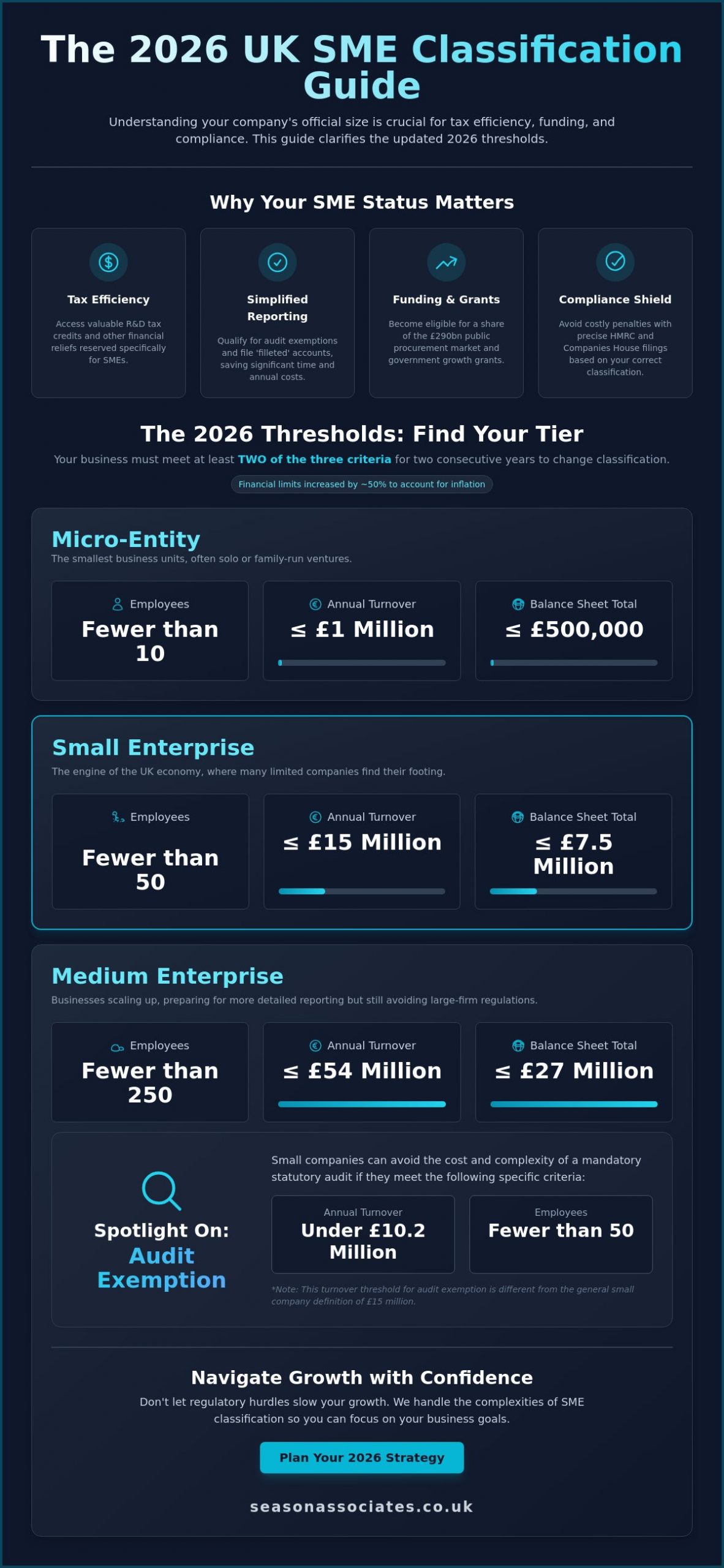
Financial limits have seen a significant uplift for 2026. The annual turnover ceiling for a medium-sized enterprise is now £54 million, up from the previous £36 million. Your balance sheet total, which includes all your assets before liabilities, must not exceed £27 million. At Season Associates, we look beyond the books to ensure you’re monitoring these records closely. Accuracy here prevents a sudden jump into a more complex tax bracket that could catch you off guard.
Micro, Small, or Medium? Identifying Your Tier
- Micro-entities: These are the smallest units, often family-run or solo ventures. You’re a micro-entity if you have fewer than 10 employees, a turnover of £1 million or less, and a balance sheet not exceeding £500,000.
- Small Enterprises: This is the sweet spot for many UK limited companies. You’ll have fewer than 50 staff, a turnover up to £15 million, and a balance sheet total of £7.5 million or less.
- Medium Enterprises: As you scale towards 250 staff, you’ll enter this tier. With turnover up to £54 million, you’ll need to prepare for more detailed reporting, though you still avoid the most strenuous large-firm regulations.
Identifying your tier is the first step toward a reliable financial strategy. It relieves you with all the complication of wondering which HMRC rules apply to your specific situation. With just a click of your finger, our team can help you categorise your business accurately and ensure your 2026 filings are flawless.
Why SME Classification Matters for Your Financial Strategy
Are you wondering why the sme tag is so vital for your business growth? It isn’t just a statistical category used by the government. It defines your access to the £290 billion public procurement market and dictates your total tax liability. Your status determines whether you can bid for lucrative local authority contracts or if you qualify for specific grants designed to help smaller firms scale. The UK government previously targeted 33% of its procurement spend to reach smaller organisations, a trend that continues to influence financial strategies for UK SMEs as we move through 2026.
Audit Exemptions and Simplified Accounts
Does your business meet the criteria for a small company? If your turnover is under £10.2 million and you have fewer than 50 employees, you likely qualify for a statutory audit exemption. This relief removes the mandatory requirement for an independent auditor to verify your books; this significantly lowers your annual overheads and reduces administrative stress. You can also choose to file “filleted” or abridged accounts at Companies House. This allows you to keep your profit and loss account private, protecting your competitive data whilst maintaining enough transparency to satisfy lenders. We ensure these filings are handled with no hidden charges, keeping your records accurate and compliant.
SME-Specific Tax Incentives
Tax planning is where your sme status truly shines. The R&D Tax Credit scheme remains one of the most generous incentives in the UK; it allows you to deduct an extra 86% of qualifying costs from your yearly profit. If your firm is currently loss-making, you can even claim a tax credit worth up to 10% of the surrenderable loss. Additionally, the Annual Investment Allowance (AIA) provides 100% tax relief on qualifying plant and machinery up to a £1 million limit.
Season Associates identifies these overlooked tax planning opportunities to ensure your business can flourish. We go beyond the books to provide the calm competence you need to focus solely and truly on your goals while we shield you from HMRC complications. By monitoring your records closely, we turn your classification into a strategic advantage rather than just a label on a spreadsheet.
Common Compliance Hurdles for Growing UK SMEs
Are you prepared for the sudden shift in responsibilities that comes with rapid growth? Scaling an sme involves more than just increasing turnover; it triggers a cascade of new regulatory requirements that can catch even the most diligent directors off guard. Many business owners face a “cliff-edge” effect where a single pound of extra revenue or one additional hire necessitates a complete overhaul of their reporting systems. As the UK Government defines SMEs based on specific thresholds of employees and turnover, crossing these boundaries means moving from simple accounts to more rigorous disclosure requirements or even statutory audits.
Staying on the right side of HMRC during expansion requires a proactive rather than reactive mindset. When your business flourishes, the complexity of your tax affairs naturally deepens. Without detailed tax planning, you risk falling into traps related to Corporation Tax margins or complex VAT place-of-supply rules. We act as a reliable shield against these complications, ensuring your records are monitored closely so you never face unexpected fines as you climb the tiers of business size.
Navigating Making Tax Digital (MTD)
Managing your VAT obligations becomes a top priority once your taxable turnover exceeds the £90,000 threshold. Under MTD rules, you must keep digital records and submit quarterly returns through HMRC-compatible software. By April 2026, this digital mandate expands significantly to include Income Tax Self-Assessment for many self-employed individuals and landlords with income over £50,000. This shift ensures accuracy but adds a layer of admin that can distract you from your mission. Our approach goes beyond the books to implement cloud systems like Xero, allowing you to handle these submissions with just a click of your finger.
Managing Payroll and RTI Submissions
Hiring your first employee is a proud milestone, yet it introduces the world of PAYE and pension auto-enrolment responsibilities. HMRC requires Real-Time Information (RTI) submissions every time you pay a staff member. Even a minor delay or a small error in a National Insurance calculation can result in a £100 penalty. Ensuring your sme remains compliant whilst scaling requires a system that prioritises accuracy and timeliness. Outsourcing these technical payroll tasks provides a reliable framework for growth, giving you the freedom to focus solely and truly on your goals without the stress of monthly filing deadlines.
Compliance shouldn’t be a barrier to your potential. By automating digital record-keeping and outsourcing complex RTI submissions, you remove the friction of growth. This professional oversight ensures that as you move between sme tiers, your transition is seamless, transparent, and entirely free from hidden charges.
Practical Financial Management: Beyond the Books
Are you struggling to keep track of every penny whilst trying to grow your business? Cash flow management remains the primary reason why approximately 60% of UK businesses fail within their first five years. As we move through 2026, this challenge is intensified by fluctuating interest rates and the lingering effects of inflation. For the modern sme, waiting for an annual sit-down with an accountant is no longer a viable strategy. You need a system that provides a shield against financial uncertainty.
Moving beyond the books means transforming your financial data into a live roadmap. When you have access to real-time information, you can make decisions based on what’s in the bank today, not what was there six months ago. This proactive approach ensures your business is always investment-ready. Whether you’re seeking a bank loan or private equity, having organised, digital records demonstrates that you’re a diligent guardian of your company’s potential. It shifts your relationship with HMRC from a source of anxiety to a managed part of your operations.
Leveraging Cloud Accounting Technology
Cloud platforms have revolutionised how a sme operates. Xero and QuickBooks remain the market leaders for scalability, whilst FreeAgent is often the preferred choice for smaller, service-based entities. By automating bank feeds and invoice processing, you can reduce manual data entry errors by up to 80%. This automation typically saves business owners roughly 10 hours of admin every month. With your data in the cloud, we can collaborate with you instantly; checking your figures is possible with just a click of your finger. This transparency allows us to spot potential VAT or Corporation Tax issues before they escalate into costly investigations.
Strategic Tax Planning for Directors
Effective tax planning isn’t about cutting corners; it’s about using the 2026 regulations to your advantage. Most directors find the most efficiency by balancing a low salary with dividend payments. For the 2025/26 tax year, the dividend allowance remains at £500, with tax rates set at 8.75% for basic rate payers, 33.75% for higher rate, and 39.35% for additional rate. We help you monitor your director loan accounts closely to avoid the 33.75% S455 tax charge on overdrawn balances. Our goal is to ensure your statutory filings are accurate and timely, allowing you to flourish without the fear of hidden charges or penalties.
Don’t let complex HMRC regulations hold your business back from its true potential. We provide the expert guidance you need to stay compliant and profitable. Get started today with our professional accounting services and focus solely on your goals.
How Season Associates Empowers Your SME Growth
Are you feeling overwhelmed by the financial demands of running your business? At Season Associates, we believe that accounting should be a catalyst for your success rather than a source of stress. We adopt a “beyond the books” approach, which means we don’t just crunch numbers; we provide holistic support designed to help your SME thrive in an increasingly complex market. Our service is built on the foundation of transparency. You’ll benefit from fixed-fee monthly retainers with no hidden charges, ensuring you can manage your cash flow with total confidence and zero surprises.
HMRC investigations and the threat of heavy fines can keep even the most seasoned entrepreneur awake at night. We act as your diligent guardian, monitoring your records closely to shield you from complications before they arise. Our team provides specialised support for CIS contractors, sole traders, and limited companies, tailored to the specific regulations of the United Kingdom. By handling the technicalities of Corporation Tax and VAT, we allow you to focus solely and truly on your primary business goals.
- Holistic Support: Strategic advice that looks at the big picture of your business health.
- Transparent Pricing: Fixed monthly fees that help you plan your budget accurately.
- Regulatory Protection: Proactive monitoring to prevent HMRC disputes and penalties.
- Diverse Expertise: Deep understanding of CIS, sole trader, and limited company structures.
Tailored Solutions for Every Stage
We support you throughout your entire business journey. This starts with seamless company formation and evolves into providing advanced management accounts that drive strategic decisions. Our team offers specialist advice for niche sectors, including healthcare and charities, where regulatory requirements are often more complex. We understand the unique pressures of owning an SME because we’ve helped hundreds of owners navigate the same hurdles. You aren’t just another file in a cabinet; you’re a partner whose success is our priority.
Your Next Steps to Financial Clarity
Achieving financial peace of mind starts with a simple conversation. A free consultation with our experts can often identify immediate tax savings that you might have overlooked. We also specialise in transitioning your bookkeeping to modern, cloud-based systems like Xero or QuickBooks. These tools provide real-time information with just a click of your finger, making the transition to “Making Tax Digital” effortless. Enquire today to see how we can help your business flourish.
Take Control of Your Business Potential in 2026
Navigating the evolving landscape of the UK sme sector requires more than just keeping up with new definitions. It demands a proactive approach to financial strategy and a commitment to modern compliance standards. By mastering the 2026 classification criteria and moving your financial management into the cloud, you’re not just ticking boxes; you’re building a resilient foundation for long-term success. Accurate record-keeping and real-time insights are the tools that allow you to anticipate hurdles before they become fines.
At Season Associates, we’ve spent over 10 years supporting UK small businesses through every regulatory shift. Our specialists leverage cloud accounting platforms like Xero and QuickBooks to provide you with the clarity you need to flourish. We believe in total transparency, which is why we offer fixed-fee pricing with no hidden charges. This approach goes beyond the books, relieving you of complex HMRC burdens so you can focus solely and truly on your goals. Let us act as your tech-savvy mentor and diligent guardian in an increasingly digital world.
Ready to see how expert guidance can transform your financial outlook? Book a free consultation with our SME experts today. It’s time to accomplish your vision with a partner you can trust.
Frequently Asked Questions
What is the exact definition of an SME in the UK for 2026?
An SME in the UK is defined as a business that employs fewer than 250 people and has either a turnover below £36 million or a balance sheet total under £18 million. These updated 2026 thresholds ensure that your business receives the specific regulatory exemptions it deserves. By monitoring records closely, we ensure your sme status remains accurate as you flourish and scale. This classification is vital for accessing tailored financial support.
Can a sole trader be considered an SME?
Yes, a sole trader is classified as an SME because they fall within the micro-enterprise threshold of fewer than 10 employees and a turnover below £2 million. Are you a sole trader worried about the paperwork? While the term often applies to limited companies, the government treats all small-scale operations under these caps as part of the SME sector. This status helps you access specific schemes designed to help you reach your full potential.
Do I need an audit if my business is classified as an SME?
You don’t need a statutory audit if your business qualifies as a small company by meeting at least two criteria: turnover under £10.2 million, assets under £5.1 million, or 50 or fewer employees. This exemption relieves you of a significant administrative burden and unnecessary costs. We focus on detailed tax planning to ensure your records are accurate, so you can focus solely and truly on your goals without the stress of audits.
What are the turnover limits for a small business vs a medium business?
A small business has a turnover limit of £10.2 million, whilst a medium-sized business can turn over up to £36 million. To be small, you must also have a balance sheet under £5.1 million and fewer than 50 staff. For a medium business, these limits rise to £18 million in assets and 250 employees. Understanding these boundaries is vital for your corporation tax strategy and long-term financial health as you grow.
How does SME status affect my R&D tax credit claim?
Your status allows you to access the merged R&D tax relief scheme, which provides a net benefit of approximately 15% for loss-making companies and 16.2% for profit-making ones. These rates apply specifically if you’re an intensive sme with R&D spend making up 30% or more of your total expenditure. Our team goes beyond the books to identify every eligible penny, ensuring your innovation translates into real-time tax savings and business growth.
What happens if my business grows beyond the SME threshold mid-year?
If your business exceeds the threshold mid-year, you usually retain your current status for that financial year because of the two-year rule. You must exceed the limits for two consecutive years before your classification officially changes. This grace period provides a reliable shield against sudden regulatory shifts. It gives you the breathing room to organise your finances and prepare for the increased reporting requirements of a larger enterprise without immediate panic.
Is Making Tax Digital mandatory for all SMEs in 2026?
Making Tax Digital is mandatory for all SMEs in 2026, as the rollout now includes self-employed individuals and landlords with income over £30,000. This transition ensures your financial information is accurate and accessible with just a click of your finger. By using cloud-based systems like Xero or QuickBooks, we help you stay compliant with HMRC regulations while providing the real-time information you need to flourish and avoid potential fines.
How much does an SME accountant typically cost in the UK?
An SME accountant in the UK typically costs between £60 and £250 per month for basic bookkeeping and tax services, depending on your business complexity. Larger medium-sized firms might pay upwards of £5,000 annually for comprehensive support including payroll and VAT management. We pride ourselves on offering a prominent service with no hidden charges. This transparency ensures you can budget effectively while we protect your business and manage your capital gain tax.